Wajid Mahmood was ordered to pay a reported £5,601.54 after pleading guilty to failing to comply with an improvement notice for a jointly owned rental property in Bawdlands, Clitheroe.
The case followed repeated complaints about extensive disrepair, including no hot running water, significant damp and mould, faulty electrics, a defective boiler and an entrance door that did not lock.
Blackburn magistrates imposed a £2,025 fine and ordered Mahmood to pay £2,846.54 in costs. However, those two published amounts total £4,871.54, leaving £730 of the reported overall sum unexplained in the public account.
Key Takeaways
- Mahmood, 41, pleaded guilty at the first opportunity.
- Two successive tenants reportedly raised concerns.
- Most required repairs remained incomplete at a follow-up inspection.
- The second joint owner’s charge was discontinued.
- The published financial breakdown does not reconcile with the reported total.
The prosecution was announced on 24 July 2026 and concerned failure to follow a formal notice rather than an isolated maintenance complaint.
Why Was Wajid Mahmood Fined Over the Clitheroe Rental Property?
The Wajid Mahmood landlord fine followed his guilty plea to failing to comply with an improvement notice issued after environmental health officers inspected a privately rented property in Bawdlands.
According to the official prosecution case account, the property had fallen into extensive disrepair and its owners had been contacted about necessary repairs.
The council later served a formal notice requiring remedial work, but a subsequent inspection found that most of the listed repairs had not been completed.
That distinction is important. The prosecution was not reported as punishment simply because a boiler broke or a tenant made one complaint; it concerned alleged non-compliance after the authority had inspected the property, identified hazards and formally required action.
Mahmood pleaded guilty in the case brought by the local authority. The guilty plea resolved the charge against him and allowed the court to move to sentencing and consideration of mitigation.
What Problems Were Reported at Wajid Mahmood’s Rental House?
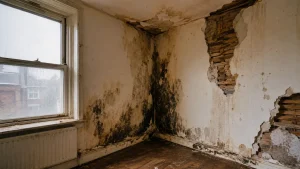
The council’s account identified several defects affecting basic warmth, hygiene, electrical safety and security. The reported conditions went beyond cosmetic deterioration.
Hazards And Repair Failures
- The ground-floor entrance door reportedly did not lock.
- The shower was said to run only cold.
- There was no hot running water.
- Inspectors found significant damp and mould growth.
- The boiler was described as defective.
- Electrical installations were reported as faulty.
- One tenant was reportedly unable to wash properly.
These conditions were identified after the tenant made further calls about extensive disrepair and environmental health staff inspected the flat.
One competitor report also described “fire safety issues throughout”. However, the primary public statement did not separately list a confirmed fire-safety defect; it referred to faulty electrics, an unsecured door, damp and mould, a defective boiler and no hot water.
The narrower primary-source description is therefore the more reliable wording.
The article should similarly avoid assigning the hazards to category 1 or category 2 under the Housing Health and Safety Rating System because the council did not publish their individual scores or classifications.
How Did the Council’s Investigation Lead to Prosecution?
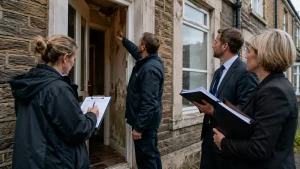
The sequence shows how an unresolved complaint developed into inspection, formal enforcement and criminal proceedings. It also indicates that the owners were contacted before the prosecution was started.
The First Tenant Complaint
The ground-floor tenant initially contacted the council because the front door did not lock and the shower was not working properly, reportedly supplying only cold water. The owners were then asked to carry out the necessary repairs.
The tenant later made further calls reporting wider disrepair. Environmental health officers inspected the flat and recorded the damp and mould, defective boiler, faulty electrics and absence of hot running water.
This chronology indicates that the council’s intervention escalated after continuing reports rather than moving directly from a first complaint to court action.
What Happened After The Improvement Notice?
Following the inspection, the landlords were served with an improvement notice requiring remedial works. A new tenant later moved into the property and also complained about continuing problems.
Council staff then carried out another inspection. That visit reportedly found that the majority of the repairs listed in the notice had not been completed, after which prosecution proceedings were brought.
The appearance of a second tenant is a significant detail because it suggests that the concerns continued beyond the original occupancy. It also demonstrates why landlords and agents should verify completion before a property is re-let.
How Much Was The Wajid Mahmood Landlord Fine?
The public account describes the outcome as £5,601.54, commonly rounded in headlines to £5,600. Yet the stated fine and prosecution costs do not add up to that reported total.
Published Financial Breakdown
| Financial Element | Amount |
| Fine imposed by magistrates | £2,025 |
| Costs ordered | £2,846.54 |
| Mathematical total | £4,871.54 |
| Reported overall total | £5,601.54 |
| Unexplained difference | £730 |
The £730 difference is not explained in the published statement. There may have been another court-imposed amount, but no such component is identified in the material currently available, so it would be unsafe to label it as a surcharge, compensation or another fee.
Several reports repeated the £5,601.54 figure while also reproducing the £2,025 fine and £2,846.54 costs. The discrepancy therefore appears to originate in the source breakdown rather than in a later independent calculation.
The accurate formulation is that Mahmood was fined £2,025, ordered to pay £2,846.54 in stated costs and reported as facing a total financial order of £5,601.54.
How Were The Tenants Affected By The Property Conditions?
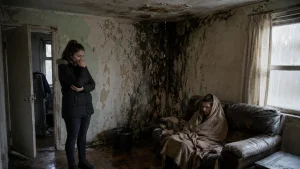
Magistrates were told that the poor condition of the property and the prolonged effort to secure repairs had seriously affected the first tenant’s mental health. The tenant was also said to have been unable to wash properly because hot running water was unavailable.
Councillor Mark Hindle, chairman of the health and housing committee, said:
“Rented properties should be safe, clean and secure and landlords have a moral, as well as legal, duty.”
He also said the lack of essentials such as hot water or heating had affected the tenant’s mental and physical wellbeing. These statements describe what the court was told and the council’s assessment; they should not be presented as a separate clinical diagnosis.
The reported presence of damp and mould is nevertheless relevant to health.
Current official guidance says damp and mould can affect physical and mental health and advises housing providers to respond urgently, investigate underlying causes and avoid delaying action while waiting for medical evidence.
A later tenant also contacted the council about continuing problems, supporting the authority’s position that the issues had not been fully resolved after the initial notice.
What Did The Court Hear About Mahmood’s Response And Mitigation?
The magistrates were given information about Mahmood’s plea, personal circumstances and the later status of the repairs. Mitigation explained the circumstances put forward on his behalf but did not reverse the guilty plea.
Guilty Plea And Acceptance Of Mistakes
Mahmood pleaded guilty at the first opportunity and accepted that mistakes had been made. He also acknowledged that the works had been carried out later than they should have been.
The official account says the court was told that he had “lost his good character”. One secondary report interpreted the mitigation as meaning he had no previous convictions, but the primary statement does not use that exact formulation.
Why Were Family Circumstances Raised?
The court heard that a close family member had serious health problems requiring Mahmood’s time and attention. This was presented as mitigation for the delay rather than as a denial that the improvement notice had been breached.
Reporting the personal circumstances gives a balanced account of the hearing. It does not establish that those circumstances legally excused the delayed work, and the published report does not say that the court accepted a formal reasonable-excuse defence.
Status Of The Repairs
Mahmood accepted that the work had been late, but the court was told that most of it had since been completed. One competitor described the remediation as almost complete, although “most had now been completed” is the more precise official wording.
No full repair schedule, completion date or final compliance inspection was published. It is therefore unclear which items remained outstanding at the time of the hearing.
Why Was The Charge Against The Second Property Owner Discontinued?

The Bawdlands property was jointly owned by Mahmood and another man, and both were initially charged. After Mahmood pleaded guilty, the council discontinued the charge against the second owner because it considered that continuing was not in the public interest.
A discontinued charge is not the same as a conviction. It should also not automatically be described as an acquittal because the public account says the prosecution was withdrawn rather than determined following a contested trial.
The second owner was not named in the published statement. Responsible reporting should therefore avoid speculation about that person’s conduct, involvement or reasons for the council’s decision beyond the public-interest explanation provided.
The case nevertheless illustrates that jointly owned properties can create enforcement questions involving more than one responsible person. Owners and managing agents should ensure that responsibility for inspections, repairs and statutory correspondence is clearly allocated and documented.
What Does The Case Show About Landlord Improvement Notices?
The case demonstrates the difference between receiving an informal request for repairs and being served with a formal enforcement document. Once operative, an improvement notice carries statutory consequences.
How An Improvement Notice Works?
The Housing Health and Safety Rating System is used by local authorities to assess risks to the health and safety of people in residential properties. The current HHSRS enforcement guidance applies in England, covers 21 potential hazards and requires action on category 1 hazards while allowing action on category 2 hazards.
An improvement notice specifies remedial action and the period for compliance. Section 30 of the Housing Act 2004 provides that failure to comply with an operative notice is an offence.
The specific hazard categories in Mahmood’s case were not published, so no category should be inferred from the general rules.
Lessons For Landlords And Letting Agents
The practical lesson is that repair management must continue from the first report through inspection, completion and verification.
Compliance Priorities
- Record the date every tenant complaint is received.
- Inspect urgent heating, hot-water, electrical and security defects promptly.
- Read each requirement and deadline in a formal notice.
- Retain photographs, invoices and contractor reports.
- Inform the council when work is completed.
- Check repairs before granting a new tenancy.
- Arrange follow-up checks for recurring damp and mould.
Official damp-and-mould guidance also recommends documenting reports, addressing underlying causes and inspecting again after remedial work to confirm the problem has not returned.
Good records cannot replace the repairs themselves, but they can show what was reported, what action was taken and whether compliance was achieved.
What Can Tenants Do When Serious Rental Repairs Are Ignored?
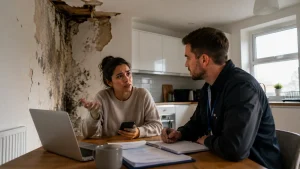
Tenants facing unresolved hazards should create a clear written record and escalate concerns proportionately. The process is stronger when dates, photographs and previous communications are available.
Practical Reporting Steps
- Report each defect to the landlord or agent in writing.
- Include photographs or video where appropriate.
- Keep copies of emails, messages and letters.
- Record periods without hot water or heating.
- Note unsuccessful or delayed repair visits.
- Provide reasonable access for inspections.
- Contact the council if serious risks remain unresolved.
- Seek urgent assistance where there is immediate danger.
The official tenant safety guidance says tenants should put concerns in writing, provide supporting images where useful and retain communications. It also explains that councils may take enforcement action when private landlords or housing associations do not carry out necessary repairs or improvements.
Council involvement does not guarantee a particular enforcement outcome because officers must inspect the evidence, assess the risks and select an appropriate response. However, the Mahmood case shows that repeated, documented reports can lead to inspection and formal action where significant problems remain.
Conclusion
The Wajid Mahmood landlord fine arose after repeated complaints, an environmental health inspection, a formal improvement notice and a follow-up visit that reportedly found most required repairs incomplete.
The case involved fundamental living conditions: hot water, heating, electrical safety, damp and mould, and a secure entrance. It also involved two successive tenants, demonstrating why completing and checking repairs between tenancies is essential.
Mahmood pleaded guilty at the first opportunity, accepted that mistakes had been made and presented family-health circumstances in mitigation. The court was also told that most of the work had subsequently been completed.
The official account reports a £2,025 fine, £2,846.54 in costs and a total of £5,601.54. Because the first two figures equal £4,871.54, the unexplained £730 difference should remain clearly identified rather than filled with speculation.
Frequently Asked Questions
Was “Rogue Landlord” The Court’s Formal Description?
The term appeared in the council’s news headline, but the reported offence was failure to comply with an improvement notice. A neutral report can describe Mahmood by the offence to which he pleaded guilty.
Where Is Bawdlands?
Bawdlands is in Clitheroe, Lancashire, and was identified as the location of the jointly owned rental property. Mahmood’s own address was reported separately as Holden Street, Clitheroe.
Were Fire-Safety Breaches Officially Confirmed?
One secondary article mentioned fire-safety issues, but the council did not separately list a fire hazard. Its stated findings included faulty electrics, damp and mould, a defective boiler, no hot water and an unsecured door.
Did Mahmood Have Previous Convictions?
One report said he had no previous convictions, while the official account said he had lost his good character. Without the underlying court record, the more cautious approach is to retain the official wording.
Were All Repairs Finished Before Sentencing?
The court was told that most of the work had been completed, not necessarily all of it. No final schedule or completion certificate was included in the public statement.
Does Joint Ownership Remove Individual Responsibility?
Joint ownership does not by itself establish which owner is legally liable for every act or omission. In this case, Mahmood pleaded guilty and the charge against the other owner was discontinued on public-interest grounds.
Could Tenants Take Other Action After Council Enforcement?
Council action may exist alongside other housing remedies, depending on the tenancy, evidence and legal circumstances. The public account does not state whether either tenant pursued a separate claim.
Note: The financial total is reported exactly as published, but its component figures do not reconcile. No publicly available court breakdown reviewed for this article explains the additional £730.