If the property is in England or Wales, four tenants will not normally trigger mandatory HMO licensing because that generally applies when at least five people from more than one household share facilities.
However, a council’s additional licensing scheme may cover properties occupied by three or four tenants.
The rules are different in Scotland and Northern Ireland, where a property shared by four unrelated tenants will usually require an HMO licence. The number of households, location, property arrangement and local licensing rules must therefore be checked before letting begins.
Is a Property With Four Tenants an HMO?
In England and Wales, a property will generally be an HMO when:
- At least three people occupy it as their main home.
- They form more than one household.
- They share a kitchen, bathroom or toilet.
This means a house occupied by four unrelated friends will usually be an HMO, even though it may not require a mandatory HMO licence.
An HMO’s legal status and its licensing status are separate questions. A property can be an HMO without falling within the national mandatory licensing scheme.
Certain converted buildings containing self-contained flats can also be treated as HMOs under separate rules, even where tenants do not share a kitchen or bathroom.
Do Four Tenants Need an HMO Licence in England?
A property with four tenants does not usually require a mandatory HMO licence in England. Mandatory licensing normally covers a property occupied by at least five people who form more than one household and share facilities.
However, a licence may still be required if the council operates an additional licensing scheme.
Councils can introduce these schemes to bring smaller HMOs, including properties occupied by three or four people, into licensing.
For example, four unrelated professionals sharing a house could require an additional HMO licence in one council area but not in another. The landlord cannot determine the answer from the number of occupants alone.
The position can also change when a council introduces, expands or renews a licensing designation.
Landlords should check the current scheme rather than relying on information received when the property was purchased.
What Is the Difference Between Mandatory, Additional and Selective Licensing?
The three main licensing categories should not be treated as interchangeable.
| Licensing Type | Properties Normally Covered | Could It Affect Four Tenants? |
| Mandatory HMO licensing | HMOs occupied by at least five people from more than one household | Usually no |
| Additional HMO licensing | Smaller HMOs included in a local council designation | Yes |
| Selective licensing | Privately rented properties within a designated area | Yes, depending on the scheme and exemptions |
Additional licensing specifically extends HMO licensing to properties outside the mandatory threshold. Selective licensing is area-based and can affect ordinary rented homes as well as some shared properties.
Local proposals can also change fees, conditions and covered streets. The distinction can be seen in plans for selective landlord licensing, where coverage depends on the property’s location rather than simply the number of tenants.
How Do Households Affect the HMO Licence Requirement?
A household is not the same as the number of tenancy agreements. Couples and members of the same family normally form one household, while unrelated friends are usually separate households.
Examples for England and Wales include:
| Occupancy Arrangement | Number of People | Likely Households | Likely HMO? |
| Four unrelated friends | 4 | 4 | Yes |
| Two couples | 4 | 2 | Yes |
| One couple and two unrelated friends | 4 | 3 | Yes |
| Parents and two children | 4 | 1 | Usually no |
| Four students on one joint tenancy | 4 | 4 | Yes |
Putting every tenant on one joint agreement does not turn them into one household. Similarly, giving tenants separate contracts does not determine whether the property is an HMO. The council looks at who lives there, their relationships and which facilities they share.
Married couples, civil partners, cohabiting couples and qualifying relatives are normally treated as members of the same household. Friends are not treated as relatives simply because they have lived together for a long time.
Do Four Tenants Need an HMO Licence in Wales?

The HMO threshold in Wales is broadly similar to England. Mandatory HMO licensing generally applies where at least five people from more than one household occupy the property and share basic facilities.
A four-tenant property can nevertheless require an HMO licence where the relevant Welsh council operates additional licensing. Landlords must therefore check the rules for the property’s exact council area.
Wales also has separate landlord registration and management licensing requirements. These obligations can apply even when the property does not require an HMO licence.
A landlord should not assume that satisfying one licensing system automatically satisfies the other.
The consequences of ignoring the wider Welsh requirements are illustrated by cases involving unlicensed rental properties in Wales.
Do Four Tenants Need an HMO Licence in Scotland?
A property occupied by four unrelated tenants in Scotland will usually require an HMO licence.
Scottish licensing generally applies where a property is occupied as the tenants’ only or main residence by three or more people from three or more families. Therefore, four unrelated friends sharing a flat will normally meet the licensing test.
Two couples may produce a different result because they represent two family units rather than three.
However, a couple sharing with two unrelated individuals will normally create three family units and may require licensing.
Scottish landlords should apply to the council responsible for the property. Operating a qualifying HMO without the required licence is a criminal offence, so the position should be confirmed before tenants move in.
Do Four Tenants Need an HMO Licence in Northern Ireland?
In Northern Ireland, a property generally falls within HMO licensing when it is the main residence of at least three people from more than two households and rent is payable by at least one occupier.
Four unrelated friends normally form four households, meaning an HMO licence will usually be required. A couple and two unrelated friends would also normally form three households.
Two couples ordinarily represent only two households, so that arrangement may fall outside the standard HMO definition in Northern Ireland. The precise living and rental arrangements should still be checked with the relevant council.
Does a Live-In Landlord Change the Answer?
A resident landlord does not automatically prevent a property from becoming an HMO. Limited exemptions can apply to an owner sharing their home with a small number of lodgers, but four paying tenants alongside a resident owner can take the property outside those exemptions.
The owner may also count as an occupier when a council assesses the property’s capacity and safety requirements.
A landlord planning to live in the property should describe the complete arrangement to the council, including the owner, partner, relatives, tenants and lodgers.
What If One Tenant Moves Out or a Fifth Tenant Moves In?
Licensing depends on the property’s actual or intended occupation.
If a four-person HMO in England or Wales gains a fifth tenant, it may enter mandatory licensing immediately, provided the occupants form more than one household and share facilities.
The landlord should not wait until the next tenancy renewal before checking the requirement.
If the number falls from five to four, an existing licence does not necessarily become irrelevant automatically. The council may need to vary, review or confirm the status of the licence.
Landlords should also avoid treating a temporarily empty room as proof that a property falls outside licensing. Councils can consider how the property is being let, advertised and intended to be occupied.
Is Planning Permission Required for a Fourren-Tenant HMO?
HMO licensing and planning permission are separate systems. Approval under one does not guarantee compliance with the other.
In England, a small HMO occupied by three to six unrelated people may fall within the C4 planning use class. Changing a standard family home into a small HMO can sometimes take place without a full planning application, but this right may be removed by a local Article 4 direction.
Where an Article 4 direction applies, planning permission may be required before changing the property from a family home to an HMO. Councils can also restrict new HMOs in areas where they consider the concentration too high.
The landlord should therefore ask both the housing licensing team and the planning department about the address.
What Standards Apply When No HMO Licence Is Required?
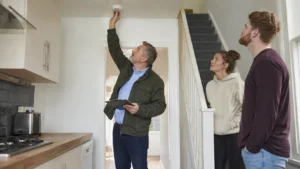
The absence of a licensing requirement does not remove the property’s HMO status or the landlord’s safety responsibilities.
A four-tenant HMO may still need appropriate fire precautions, safe electrical installations, gas-safety checks, working alarms, adequate washing and cooking facilities, suitable waste arrangements and well-maintained common areas.
The exact standards depend on the property and the relevant nation or council.
The landlord should also disclose the correct occupancy to the mortgage provider and insurer. Ordinary owner-occupier insurance may not cover a shared rental property, while an HMO may require specialist terms.
The level of furniture supplied can also affect whether landlord contents insurance is appropriate.
What Can Happen If a Four-Tenant HMO Is Unlicensed?
Where a licence is legally required, renting the property without one can expose the landlord or manager to serious consequences.
Depending on the part of the UK, these may include prosecution, financial penalties, licence restrictions and difficulty recovering possession.
In England and Wales, tenants or a local authority may also be able to seek repayment of rent in qualifying circumstances.
A council can impose licence conditions, restrict occupancy and require safety or management impovements.
A landlord should not assume that being unaware of a local additional licensing scheme will prevent enforcement.
How Can a Landlord Check Whether a Licence Is Needed?
The landlord should first count every person who will occupy the property and identify how many households they form. The next step is to establish whether kitchens, bathrooms or toilets are shared.
The property’s full address should then be checked with the local council.
The landlord should ask:
- Is the property legally an HMO?
- Is it covered by mandatory or additional HMO licensing?
- Does a selective licensing scheme apply?
- Is planning permission required for HMO use?
- Are there minimum room sizes or occupancy limits?
- Must an application be made before the tenants move in?
Obtaining the council’s response in writing can create a useful compliance record. The landlord should provide complete information because an answer based on the wrong number of occupants or households may not be reliable.
What Is the Final Answer?
Four tenants do not usually trigger mandatory HMO licensing in England or Wales, but the property may still be an HMO and could require a licence under an additional local scheme.
In Scotland, four unrelated tenants will normally require an HMO licence. In Northern Ireland, a licence will generally be needed when the four tenants form at least three households.
The safest approach is to check the property exact address, household arrangement and planning status with the council before letting begins.
Frequently Asked Questions
Do Four Friends Count as Four Households?
Yes. Four unrelated friends will normally be treated as four separate households, even if they sign one joint tenancy agreement.
Do Two Couples Need an HMO Licence?
In England and Wales, two couples sharing facilities generally create an HMO, but four occupants do not automatically trigger mandatory licensing. Local additional licensing may still apply.
Is a Student House With Four Tenants an HMO?
Four unrelated students sharing a kitchen or bathroom will normally form an HMO. Whether it needs a licence depends on the country and local licensing scheme.
Can a Landlord Avoid Licensing by Using One Tenancy Agreement?
No. HMO status is based on occupation, household relationships and shared facilities, not simply the number of tenancy agreements.
Does Every Bedroom Need to Meet a Minimum Size?
Licensed HMOs are subject to occupancy and room-size standards. Councils may impose additional local requirements, so every bedroom should be checked before it is offered to a tenant.
Does an HMO Licence Cover Planning Permission?
No. Licensing and planning are separate. A landlord may need both an HMO licence and planning permission, particularly in an Article 4 area.
Can Tenants Check Whether Their HMO Is Licensed?
Yes. Tenants can contact the local council’s private housing or HMO licensing team and ask whether the property appears on its public register.