In England and Northern Ireland, Stamp Duty Land Tax (SDLT) is normally payable within 14 calendar days of completing a property purchase.
The buyer is responsible for the tax, although their solicitor or conveyancer usually submits the return and arranges payment as part of the conveyancing process.
You generally do not pay stamp duty when making an offer, arranging a mortgage or exchanging contracts. The payment obligation normally arises when the transaction completes, although special rules can bring the effective date forward.
The amount payable depends on the property’s value, whether you are a first-time buyer, whether you already own another property and whether additional surcharges apply.
The rules also differ across the UK. Scotland uses Land and Buildings Transaction Tax (LBTT), while Wales uses Land Transaction Tax (LTT), with different rates and filing deadlines.
| Property purchase detail | Current rule |
| England and Northern Ireland payment deadline | Within 14 calendar days |
| Scotland payment deadline | Within 30 days |
| Wales payment deadline | Within 30 days |
| Who pays? | Usually the buyer |
| Standard SDLT tax-free threshold | £125,000 |
| First-time buyer tax-free threshold | £300,000 |
| Maximum property price for first-time buyer relief | £500,000 |
| Additional-property surcharge | 5 percentage points |
| Non-UK resident surcharge | Usually 2 percentage points |
| Initial late-return penalty | £100 |
Understanding these rules before exchanging contracts is important because stamp duty can add thousands of pounds to the amount needed to complete a purchase.
When Do You Actually Pay Stamp Duty on a House?
For most residential property purchases in England and Northern Ireland, stamp duty becomes payable when the property transaction completes.
Completion is when the balance of the purchase price is transferred and legal ownership passes to the buyer.
At this point, the buyer becomes responsible for any SDLT due.
The official payment deadline is 14 calendar days after the effective transaction date, which is normally completion.
For example, if a house purchase completes on 10 June, the SDLT return and payment will normally be due by 24 June.
However, most buyers will not need to make a separate payment to HMRC after moving in.
Their conveyancer usually collects the stamp duty funds before completion and arranges the necessary payment and paperwork.
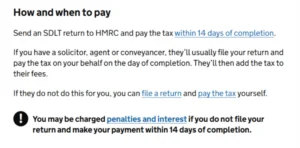
Official GOV.UK guidance confirming the 14-day Stamp Duty Land Tax payment deadline after property completion.
What Happens on Completion Day?
A typical property transaction follows this sequence:
- The buyer and seller exchange contracts.
- The conveyancer confirms the completion arrangements.
- The buyer transfers any outstanding funds.
- Mortgage funds are released where applicable.
- The seller receives the purchase money.
- Legal completion takes place.
- The conveyancer submits the SDLT return.
- Any stamp duty due is paid to HMRC.
The key distinction is between when the buyer provides the money to the conveyancer and when the legal tax deadline expires.
Although HMRC allows 14 days, the conveyancer will usually expect sufficient funds to be available before completion.
Do You Pay Stamp Duty Before or After Completion?
Stamp duty is normally paid after completion for tax purposes, but buyers usually provide the money beforehand.
This often creates confusion because a conveyancing completion statement may include stamp duty alongside the deposit, legal fees and other purchase costs.
Consider a buyer purchasing a £400,000 property.
| Cost | Example amount |
| Purchase price | £400,000 |
| Mortgage deposit at 10% | £40,000 |
| Standard SDLT | £10,000 |
| Other buying costs | Additional |
| Total cash required | Deposit + SDLT + fees |
The buyer generally needs the funds available to complete the purchase, even though the statutory SDLT payment deadline comes afterwards.
Property expert Colleen Babcock has highlighted the wider financial difficulty facing buyers:
“First-time buyers are already facing significant challenges, from higher mortgage costs to rising rents while they save.”
Her comments reflect why upfront transaction costs can affect affordability even when the buyer has already secured a mortgage offer.
The full purchase budget should therefore account for hidden costs when buying a house, rather than focusing only on the deposit.
How Much Stamp Duty Do You Pay in England and Northern Ireland?
The standard residential SDLT rates currently start at 0% on the first £125,000 of the purchase price.
The tax is progressive, meaning each rate applies only to the relevant portion of the property’s value.
The current bands are:
| Property price band | Standard SDLT rate |
| Up to £125,000 | 0% |
| £125,001–£250,000 | 2% |
| £250,001–£925,000 | 5% |
| £925,001–£1.5 million | 10% |
| Above £1.5 million | 12% |
These are the standard rates for an eligible buyer purchasing a single residential property.
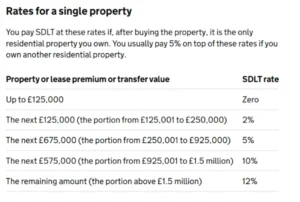
Current HMRC residential stamp duty rates and tax thresholds for property buyers in England and Northern Ireland.
Example: Buying a £400,000 Home
Suppose someone is buying a £400,000 house as their only residential property.
Their stamp duty would be calculated as follows:
| Portion of purchase price | Rate | SDLT |
| First £125,000 | 0% | £0 |
| Next £125,000 | 2% | £2,500 |
| Remaining £150,000 | 5% | £7,500 |
| Total | £10,000 |
This is different from applying 5% to the whole £400,000 purchase price.
The progressive structure ensures the buyer pays the relevant rate on each portion rather than one flat rate across the entire transaction.
When Do First-Time Buyers Have to Pay Stamp Duty?
First-time buyers in England and Northern Ireland can benefit from a higher tax-free threshold.
Under current rules:
- No SDLT is payable on the first £300,000.
- The portion between £300,001 and £500,000 is taxed at 5%.
- First-time buyer relief is unavailable if the total property price exceeds £500,000.
To qualify, the buyer must meet the relevant first-time buyer conditions, and the property must be intended as their only or main residence.
Where two or more people purchase jointly, all purchasers must satisfy the first-time buyer requirements.
| Property purchase price | Qualifying first-time buyer SDLT |
| £250,000 | £0 |
| £300,000 | £0 |
| £350,000 | £2,500 |
| £400,000 | £5,000 |
| £450,000 | £7,500 |
| £500,000 | £10,000 |
| £600,000 | £20,000 under standard rates |
The £600,000 example is particularly important.
A first-time buyer purchasing a property above £500,000 does not receive relief on the first £300,000. Instead, the normal SDLT rates apply to the entire transaction.
People considering their first purchase should also examine the available government support schemes for first-time buyers, as eligibility requirements can differ considerably between programmes.
Why the £500,000 Limit Matters?
The upper eligibility limit can create a significant change in the tax bill.
For example:
- A qualifying first-time buyer purchasing for £500,000 pays £10,000.
- A first-time buyer purchasing for £500,001 loses the relief and pays under the ordinary rates.
The difference can be substantial even though the purchase prices are almost identical.
This makes it particularly important to calculate SDLT before agreeing a final purchase price.
When Do You Pay Stamp Duty on a Second Home?
Buyers purchasing additional residential property in England and Northern Ireland generally pay higher SDLT rates.
The current surcharge adds five percentage points to the ordinary residential rates.
This often affects:
- Buy-to-let properties
- Holiday homes
- Second residences
- Certain company purchases
- Additional residential investments
| Property price band | Additional-property SDLT rate |
| Up to £125,000 | 5% |
| £125,001–£250,000 | 7% |
| £250,001–£925,000 | 10% |
| £925,001–£1.5 million | 15% |
| Above £1.5 million | 17% |
For example, buying an additional property for £300,000 produces an SDLT liability of £20,000 under the current higher rates.
The same purchase at ordinary residential rates would result in £5,000.
That £15,000 difference makes the surcharge an important consideration for property investors.
However, not every buyer who owns another property will necessarily pay the higher rates.
The legislation contains specific rules for replacing a main residence, ownership interests, spouses, trusts and certain other circumstances.
Understanding when higher stamp duty can be legally avoided on a second home can help buyers establish whether the surcharge actually applies.
Can You Reclaim Stamp Duty After Selling Your Previous Home?
Potentially, yes.
A common situation occurs when someone purchases a new main residence before selling their existing home.
Because they temporarily own two residential properties, the higher SDLT rates may initially apply.
If they subsequently sell or otherwise dispose of their former main residence within the qualifying period, they may be eligible to reclaim the additional-property surcharge.
The usual period for disposing of the former main residence is three years.
For example, consider someone who:
- Owns a house worth £350,000.
- Purchases a new main residence for £400,000.
- Cannot sell the old home before completing.
- Pays the higher SDLT rates on the new purchase.
- Sells the former main residence within the permitted period.
The new purchase would initially attract £30,000 SDLT at the higher rates.
If the transaction later qualifies for the refund, the standard SDLT would be £10,000.
The potential refund would therefore be £20,000.
The deadline for submitting the refund application is separate from the deadline for selling the previous home.
For recent transactions, the claim normally needs to be submitted within 12 months of the later of the former home’s sale or the filing date of the replacement property’s SDLT return.
Buyers can examine the stamp duty refund process for a second home to understand the evidence, reference numbers and claim requirements.
Who Is Responsible for Paying Stamp Duty?
The buyer is normally legally responsible for paying SDLT.
This is true whether the purchase is completed:
- With a mortgage
- With cash
- Through a limited company
- Through a qualifying shared ownership arrangement
- As an investment
- As a main residence
The seller does not normally pay SDLT merely because they are selling the property.
However, the seller may have separate tax obligations, such as Capital Gains Tax, depending on the circumstances.
A solicitor or conveyancer usually handles the SDLT paperwork and payment for the buyer.
Even where a professional submits the return, the buyer remains responsible for ensuring that the information is correct and the deadline is met.
Can You Add Stamp Duty to Your Mortgage?
Potentially, depending on the lender and the mortgage arrangement.
Some buyers may be able to structure their borrowing so that less of their available cash is needed for the overall purchase costs.
However, that does not mean HMRC allows stamp duty to be paid over the mortgage term.
The tax still has to be paid within the normal deadline.
Including the cost within borrowing can also increase the mortgage balance, interest paid and loan-to-value ratio.
For example, borrowing an additional £10,000 to cover purchase costs may result in interest being charged on that amount over the mortgage term.
Buyers should therefore consider the wider implications of adding stamp duty to a mortgage before assuming borrowing is the cheapest way to fund the tax.
Do Non-UK Residents Pay More Stamp Duty?
Certain non-UK resident buyers purchasing residential property in England and Northern Ireland must pay an additional 2% surcharge.
The surcharge can apply alongside other residential SDLT rates.
For example, a non-UK resident purchasing an additional residential property may face both:
- The 5% additional-property surcharge
- The 2% non-resident surcharge
This can create a combined increase of seven percentage points above the ordinary residential rates.
However, SDLT residence rules differ from the general statutory residence test used for other UK taxes.
The precise circumstances should therefore be checked before assuming the surcharge applies.
There are also refund provisions where qualifying buyers later meet the relevant UK residence conditions.
Do You Pay Stamp Duty in Scotland and Wales?
People frequently use the phrase “stamp duty” for property purchases across the UK.
Legally, however, different property transaction taxes apply.
| Location | Property transaction tax | Normal filing/payment deadline |
| England | Stamp Duty Land Tax | 14 days |
| Northern Ireland | Stamp Duty Land Tax | 14 days |
| Scotland | Land and Buildings Transaction Tax | 30 days |
| Wales | Land Transaction Tax | 30 days |
Scotland: Land and Buildings Transaction Tax
Scotland uses LBTT rather than SDLT.
The standard residential rates are:
| Residential purchase band | LBTT rate |
| Up to £145,000 | 0% |
| £145,001–£250,000 | 2% |
| £250,001–£325,000 | 5% |
| £325,001–£750,000 | 10% |
| Above £750,000 | 12% |
Qualifying Scottish first-time buyers can receive relief extending the nil-rate band to £175,000.
An 8% Additional Dwelling Supplement may also apply to qualifying purchases of additional residential property.
Wales: Land Transaction Tax
Wales uses LTT.
The standard residential bands are:
| Residential purchase band | LTT rate |
| Up to £225,000 | 0% |
| £225,001–£400,000 | 6% |
| £400,001–£750,000 | 7.5% |
| £750,001–£1.5 million | 10% |
| Above £1.5 million | 12% |
Wales does not offer the same separate first-time buyer relief as England and Northern Ireland.
However, its general tax-free threshold is higher.
Higher residential rates can apply to additional properties.
The important distinction is that England’s SDLT bands and 14-day deadline should not be applied automatically to property purchases in Scotland or Wales.
Do You Have to Submit a Stamp Duty Return if No Tax Is Due?
Sometimes, yes.
A transaction may still be notifiable even if the tax calculation produces a zero liability.
For example, a qualifying first-time buyer purchasing a £250,000 home may owe no SDLT but will normally still need a return to claim the relevant relief.
HMRC states that returns are generally required for notifiable transactions, including many purchases involving property worth £40,000 or more.
However, certain transactions do not require an SDLT return.
Examples can include:
- Qualifying property transfers following divorce or dissolution
- Property inherited under a will
- Genuine gifts involving no chargeable consideration
- Certain low-value transactions
- Other exempt property transfers
The exact rules depend on the legal nature of the transaction.
A property transfer involving a mortgage can also be more complicated than a straightforward gift because assuming mortgage debt may count as chargeable consideration.
What Happens if You Pay Stamp Duty Late?
Missing the SDLT filing deadline can lead to financial penalties.
HMRC distinguishes between submitting the SDLT return late and paying the tax late.
The standard late-filing penalties are:
| Delay | Potential penalty |
| Return filed after the deadline but no more than 3 months late | £100 |
| Return filed more than 3 months late | £200 |
| Return remains outstanding after 12 months | Further tax-based penalty may apply |
| Tax paid late | Interest is charged |
For a return more than 12 months overdue, the additional tax-based penalty can reach 100% of the tax due, depending on the circumstances.
This means a long delay can become substantially more expensive than the original filing penalty.
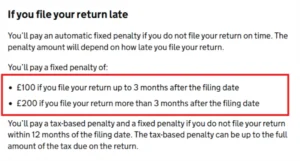
HMRC’s official late-filing penalties for Stamp Duty Land Tax returns.
Can You Appeal a Late Stamp Duty Penalty?
Yes, in certain circumstances.
HMRC can consider an appeal where the buyer has a reasonable excuse for missing the filing deadline.
An acceptable explanation generally involves an event beyond the person’s control that genuinely prevented them from filing the return or arranging for someone else to do so.
Examples may involve serious unexpected illness or exceptional disruption.
Simply forgetting about the filing obligation will not normally be sufficient.
Late-payment interest is different from a filing penalty. It is generally not appealable in the same way, although taxpayers can ask HMRC to review an incorrect calculation or explain circumstances where HMRC’s own actions caused the delay.
The important practical lesson is to contact HMRC promptly rather than allowing penalties and interest to accumulate.
How Much Stamp Duty Revenue Does the Government Collect?
Stamp duty represents a significant source of revenue from property transactions.
However, several commonly repeated figures refer to different reporting periods or different measures of tax receipts.
HMRC’s accounts for 2025–26 report £14.8 billion in Stamp Duty Land Tax receipts for England and Northern Ireland.
The more detailed annual transaction statistics currently published for 2024–25 provide the following figures:
| Measure | Reported amount | Period |
| Total SDLT receipts | £13.885 billion | 2024–25 |
| Residential SDLT receipts | £10.38 billion | 2024–25 |
| Non-residential SDLT receipts | £3.505 billion | 2024–25 |
| Higher-rate additional-dwelling receipts | £5.435 billion | 2024–25 |
| Transactions subject to the additional-dwelling surcharge | 211,700 | 2024–25 |
| First-time buyer relief transactions | 155,400 | 2024–25 |
| First-time buyer SDLT relieved | £772 million | 2024–25 |
| SDLT receipts in London | £5.14 billion | 2024–25 |
| Total SDLT receipts reported in HMRC accounts | £14.8 billion | 2025–26 |
The £5.435 billion higher-rate figure includes SDLT paid on higher-rate transactions; it should not be confused with the surcharge component alone.
Similarly, the £1.13 billion associated with non-resident transactions in the 2024–25 statistics represents total receipts on affected transactions, rather than solely the additional 2% surcharge.
The surcharge element itself was substantially smaller.
The Office for Budget Responsibility previously forecast approximately £16.4 billion in combined UK property transaction taxes for 2025–26, incorporating the devolved property taxes as well as SDLT.
That was a forecast produced before the financial year ended, not the final HMRC SDLT outturn.
Why London Contributes So Much?
London accounted for approximately 37% of total SDLT receipts in 2024–25, despite representing a much smaller proportion of national property transactions.
This largely reflects higher property prices and the concentration of expensive residential and commercial transactions.
The figures also show why stamp duty is particularly important for buyers in higher-priced regions.
Research published in July 2026 found that nearly 80% of London first-time buyers faced stamp duty, compared with fewer than one in ten in northern England.
Property analyst Richard Donnell has also highlighted how stamp duty and borrowing costs influence housing affordability and people’s willingness to move.
The practical effect is that the same first-time buyer relief threshold can have very different consequences in different local property markets.
When Should You Budget for Stamp Duty During a Property Purchase?
Stamp duty should be included in the purchase budget before making a final offer.
Waiting until completion can create a cash-flow problem, particularly for buyers already using most of their savings for the mortgage deposit.
A sensible approach is:
- Before viewing: Identify your likely property price range and SDLT position.
- Before making an offer: Calculate the tax using current rates.
- Before exchanging contracts: Confirm whether any relief or surcharge applies.
- When arranging the mortgage: Check that sufficient cash remains for SDLT and legal fees.
- Before completion: Transfer the required balance to your conveyancer.
- After completion: Confirm the SDLT return has been submitted and payment arranged.
For a buyer purchasing a £400,000 main residence, the standard £10,000 SDLT bill is a substantial additional expense.
For a buyer purchasing the same property as an additional residence, that figure may rise to £30,000.
Property type, ownership history and tax status should therefore be checked well before contracts become binding.
Conclusion
Stamp Duty Land Tax is normally payable within 14 calendar days of completing a property purchase in England or Northern Ireland, although conveyancers usually collect the funds before completion.
The amount depends on the purchase price, first-time buyer eligibility, existing property ownership and any applicable surcharges. Scotland and Wales operate separate property transaction taxes with 30-day deadlines.
Buyers should calculate the tax before exchanging contracts, confirm whether any relief applies and ensure sufficient funds are available for completion.
Missing the filing or payment deadline can lead to penalties and interest, making early planning an essential part of purchasing property.
FAQs About When You Pay Stamp Duty
When do you pay stamp duty when buying a house?
In England and Northern Ireland, SDLT is normally payable within 14 calendar days of completion. Your solicitor or conveyancer will usually collect the money before completion and arrange payment.
Do you pay stamp duty when you exchange contracts?
Usually not. The tax becomes payable when the transaction completes, although substantial performance can bring forward the effective date in certain circumstances.
Can you pay stamp duty after moving into the property?
Yes, the statutory deadline normally falls 14 days after completion. However, your conveyancer will generally require the funds beforehand.
Do first-time buyers have to pay stamp duty?
Qualifying first-time buyers in England and Northern Ireland pay no SDLT on the first £300,000 of a property costing no more than £500,000. Above that limit, normal rates apply.
Do you pay stamp duty on a £250,000 house?
An ordinary home mover generally pays £2,500 in England or Northern Ireland. A qualifying first-time buyer would normally pay £0.
Who pays stamp duty, the buyer or seller?
The buyer is normally responsible for SDLT. The seller may face separate taxes, but they do not ordinarily pay SDLT simply because they are selling their home.
Do you pay stamp duty when buying with cash?
Yes, if the transaction is chargeable. Buying with cash rather than a mortgage does not generally remove the SDLT obligation.
Can you pay stamp duty in instalments?
SDLT is normally payable in full within 14 days of the effective date. Buyers should not assume they can spread the HMRC bill over monthly instalments.
What happens if you do not pay stamp duty within 14 days?
Late payment normally leads to interest, while filing the return late can trigger penalties starting at £100. Larger penalties may apply when a return remains outstanding for an extended period.
Do you pay stamp duty in Scotland and Wales?
Property transaction taxes apply, but Scotland uses LBTT and Wales uses LTT rather than SDLT. Both generally have 30-day filing and payment deadlines.