Second home council tax evasion has become a much bigger compliance risk for property owners as councils gain stronger powers to charge premiums and government fraud teams expand the use of data matching.
Since April 2025, councils in England have been able to charge a second-home premium of up to 100% of the normal council tax bill. In practical terms, a property that would ordinarily attract £2,500 of council tax could cost as much as £5,000 where the full premium applies.
The definition is important. A second home for these purposes is generally a dwelling that is substantially furnished but has no resident using it as their sole or main residence. The local billing authority ultimately decides whether the dwelling meets the statutory definition.
At the same time, enforcement is becoming increasingly data-led.
The National Fraud Initiative now has a specific Council Tax Evasion pilot designed to identify potential undeclared second homes and empty properties by matching council records against external residency and financial-footprint information.
For homeowners, landlords and property investors, this changes the risk calculation significantly. Declaring a genuine exception is entirely legitimate. Supplying misleading information about residence, occupancy or entitlement to an exception is a very different matter.
What Is Second Home Council Tax Evasion?
Second home council tax evasion generally involves deliberately providing inaccurate information, withholding a relevant change in circumstances or presenting a property as falling outside the premium when the true facts indicate otherwise.
This can include situations where an owner:
- declares an additional property to be their main residence when it is not;
- fails to tell the council that a property has become a second home;
- continues claiming an exception after the qualifying circumstances have ended;
- provides inaccurate information about who occupies the dwelling;
- falsely claims that a property is actively being marketed;
- supplies materially inaccurate information when responding to a council investigation.
The distinction between legal tax planning and evasion matters.
Using a genuine statutory exception is not evasion. Nor is challenging an incorrect council decision or applying for discretionary relief where the rules permit it. Problems arise when the factual information supplied to obtain the lower charge is knowingly false or materially incomplete.
Homeowners considering legitimate relief should therefore understand the separate rules surrounding the second-home council tax premium and its exceptions rather than treating an exemption as an informal loophole.
How Much Council Tax Can Be Charged on a Second Home?
In England, the Local Government Finance Act framework allows billing authorities to impose a premium of up to 100% on qualifying second homes.
That means the premium is added to the ordinary charge rather than replacing it.
| Normal Council Tax Bill | 50% Premium | 100% Premium | Total With 100% Premium |
| £1,500 | £750 | £1,500 | £3,000 |
| £2,000 | £1,000 | £2,000 | £4,000 |
| £2,500 | £1,250 | £2,500 | £5,000 |
| £3,000 | £1,500 | £3,000 | £6,000 |
The maximum premium in England is therefore capable of doubling the standard bill. Councils do not have to impose the premium, however, and they can determine whether it applies throughout their area or only in particular circumstances.
Government information published during 2026 also indicated that more than two-thirds of English billing authorities had introduced second-home premiums during 2025–26, demonstrating how widely the power has already been adopted.
Harvey Dhillon, founder and CEO of Zmartly, summarised the financial exposure clearly:
“Where the council charges the second homes premium, that can mean up to twice the normal bill.”
His wider point was that homeowners who move before selling an existing furnished home need to consider council tax alongside mortgage and bridging-finance costs.
Anyone purchasing another property should also calculate the acquisition taxes separately. Our breakdown of how to avoid higher Stamp Duty on a second home legally explains circumstances where additional-property SDLT may or may not apply.
How Are Councils Detecting Second Home Council Tax Evasion?
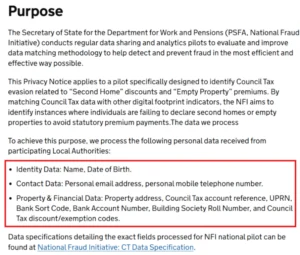
GOV.UK confirms that the NFI second-home council tax pilot uses data matching to identify potential undeclared second homes and empty properties
The most significant enforcement development is the National Fraud Initiative Council Tax Evasion pilot.
The latest official privacy notice, updated on 12 November 2026, confirms that the exercise is designed specifically to identify potential evasion connected with second homes and empty-property premiums.
Data Matching Through the National Fraud Initiative
Participating authorities can provide information including:
| Data Category | Examples Used in Matching |
| Identity | Name and date of birth |
| Contact | Personal email and mobile number |
| Property | Address, UPRN and council tax account reference |
| Financial | Bank sort code, bank account number and building society roll number |
| Council Tax Status | Discount, exemption and exception codes |
Those records can then be matched against information held by credit reference agencies to verify residency and financial footprints. The aim is to identify inconsistencies that could indicate undeclared properties or incorrect premium treatment.
The current official Council Tax evasion pilot privacy notice makes clear that participating local authorities investigate anomalies identified through the exercise.
Importantly, an automated match does not by itself prove fraud. It identifies discrepancies or patterns that may require further investigation.
What Evidence Can Support Main-Residence Status?
Where a council questions which property is someone’s main home, the issue normally turns on the reality of occupation rather than simply what address the owner prefers to nominate.
Depending on the case, authorities may examine evidence connected with:
- electoral registration;
- banking and financial correspondence;
- utility use;
- council tax records;
- employment location;
- family residence;
- school records;
- GP or other registration details;
- the length and regularity of occupation;
- information held by another council.
This is why owners moving between properties should ensure their council records correctly reflect the actual circumstances.
Our explanation of how council tax should be dealt with when moving house is particularly relevant where ownership of the former property temporarily overlaps with occupation of a new home.
How Much Second Home Council Tax Evasion Has Been Identified?
There is currently an important limitation in the national statistics.
In a parliamentary answer published on 16 January 2026, the government confirmed that it did not collect a national figure showing the level of evasion of the second-home premium, with local authorities responsible for managing individual fraud cases.
That means it would be inaccurate to claim that there is already an official UK-wide figure showing millions of pounds of second-home council tax fraud.
There is, however, strong evidence that council tax data matching more generally can recover substantial amounts.
The National Fraud Initiative’s 2022–24 reporting showed:
| NFI Council Tax Measure | Amount |
| Fraudulent Single Person Discount identified | £20.4 million |
| Amount in recovery | £20.2 million |
| Recovery rate | 99% |
Crucially, the £20.4 million figure relates to fraudulent Single Person Discounts, not second-home premium evasion. It is useful as evidence of the NFI’s wider council-tax fraud detection capability, but should not be presented as a second-home fraud total.
The newer second-home and empty-property pilot is therefore significant because it targets a category where a comprehensive national evasion figure has not yet been published.
Which Second Homes Are Legally Excluded From the Premium?
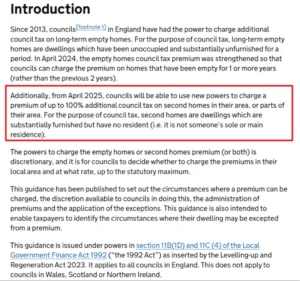
Official guidance confirms that, from April 2025, councils in England can charge up to a 100% additional council tax premium on qualifying second homes.
Not every additional property should attract the premium.
The statutory framework creates mandatory exceptions, while councils may also exercise certain discretionary powers.
The latest official guidance covering second-home premiums and exceptions sets out the current position in England.
| Exception | Typical Situation | Key Limit |
| Class E | Home linked to armed forces accommodation | Conditions must be met |
| Class F | Annex forming part of the main dwelling | Must genuinely be used with the main home |
| Class G | Property actively marketed for sale | Normally up to 12 months |
| Class H | Property actively marketed for letting | Normally up to 12 months |
| Class I | Property following probate or letters of administration | Up to 12 months from grant |
| Class J | Job-related dwelling circumstances | Employment conditions apply |
| Class K | Caravan pitch or boat mooring | Specific property type |
| Class L | Seasonal or restricted-occupation property | Planning or occupancy restrictions required |
These exceptions generally remove the premium, not automatically the underlying standard council tax liability.
Owners of residential boats or permanent moorings may face particularly different rules, which is why the position on whether council tax applies to a houseboat should be considered separately.
Why the 12-Month Marketing Exception Needs Evidence?
Properties genuinely marketed for sale or rent can receive temporary protection from the premium, but simply claiming that a property is available is unlikely to be enough where a council investigates.
Authorities may consider whether:
- the property is publicly advertised;
- the asking price or rent is realistic;
- an estate or letting agent is genuinely instructed;
- an EPC is available where required;
- there are artificial restrictions preventing a transaction;
- the owner is taking reasonable steps to secure a buyer or tenant.
The 12-month period can also run from the original date on which active marketing began, rather than automatically restarting when a council later introduces its premium.
This makes dated evidence such as agency agreements, property listings, viewing records and correspondence particularly important.
Can Changing a Second Home Into a Holiday Let Remove Council Tax?
Not automatically.
The classification of genuine holiday accommodation depends on separate non-domestic rating rules and the property’s actual letting activity. Merely describing a second home as a holiday let does not necessarily move it out of council tax.
Likewise, owners should not change the description or use of a property purely on paper while continuing to use it substantially as before.
The safer principle is straightforward: the tax classification should follow the real commercial and residential use of the property.
Property owners should also consider all taxes together rather than council tax in isolation. Those replacing a main home may, for example, have separate rights to reclaim higher-rate Stamp Duty after selling a former home.
What Is the Difference Between a Second Home and an Empty Home?
This distinction is particularly important because the premium rules are different.
| Property Status | General Meaning | Potential Premium in England |
| Second home | Substantially furnished with no sole/main resident | Up to 100% additional |
| Empty home under 1 year | Unoccupied and substantially unfurnished | Local treatment applies |
| Empty for 1–5 years | Long-term empty dwelling | Up to 100% additional |
| Empty for 5–10 years | Long-term empty dwelling | Up to 200% additional |
| Empty for 10+ years | Very long-term empty dwelling | Up to 300% additional |
A 300% empty-home premium means the owner could ultimately face four times the ordinary council tax charge: the normal 100% bill plus a 300% premium.
An important technical point is that the Class M major-repairs exception applies to qualifying empty homes, rather than providing a general second-home premium exemption simply because repair work is taking place.
What Happens If a Council Finds False Information?
Second home council tax evasion can create a much larger liability than the premium originally avoided.
A council discovering inaccurate information may reassess the property and seek payment for the correct period. Depending on the circumstances and statutory power involved, additional enforcement consequences can follow.
Schedule 3 of the Local Government Finance Act 1992 allows a £70 penalty in certain circumstances where requested council tax information is not provided or materially inaccurate information is knowingly supplied.
A further £280 penalty can apply following another request for the same information where there is continued non-compliance.
Potential consequences can therefore include:
- recalculation of council tax liability;
- removal of an incorrectly claimed exception;
- backdated second-home premiums;
- recovery of unpaid council tax;
- statutory penalties where applicable;
- formal fraud investigation;
- further enforcement or prosecution in sufficiently serious cases.
The outcome will depend on what happened, the information provided and the legal powers being used. An innocent classification dispute should not automatically be treated as deliberate fraud.
What Should Owners Do If Their Property Has Been Classified Incorrectly?
Property classification disputes are not the same as evasion.
An owner who genuinely believes their home has been incorrectly treated as a second home should first contact the billing authority and provide evidence supporting the correct position.
Useful documentation may include:
- completion statements;
- tenancy agreements;
- proof of occupation;
- probate documents;
- estate-agent contracts;
- letting agreements;
- planning restrictions;
- employment contracts for job-related accommodation;
- dated correspondence confirming when circumstances changed.
Where the issue remains unresolved, there may be a route to the Valuation Tribunal, depending on the nature of the dispute.
Keeping records is particularly important because the current NFI pilot allows identified data matches to be retained for up to five years while investigations, recovery work or enforcement activity are completed.
Why Is Second Home Council Tax Enforcement Becoming More Important?
The premium has changed the financial value of accurately identifying second homes.
Before widespread 100% premiums, an incorrect classification might have affected a relatively modest discount or charge. A full premium can now create thousands of pounds of additional annual liability for one property.
That gives councils a much stronger financial incentive to verify:
- whether a claimed main residence is genuine;
- whether a temporary exception still applies;
- whether an advertised property is genuinely available;
- whether changes in occupation have been reported;
- whether records across different datasets are consistent.
Lucian Cook, Head of Residential Research, has also noted the wider fiscal effect:
“Targeting second-home owners with tax rises has raised revenue for local government when finances are especially tight.”
The premium therefore sits at the intersection of local-government finance, housing policy and property taxation rather than operating simply as another small council tax adjustment.
What Should Second Home Owners Do to Stay Compliant?
Property owners can substantially reduce the risk of disputes by treating council tax records with the same care as other property-tax documentation.
A practical compliance process should include:
- Confirm the property’s current classification. Check whether it is genuinely a second home, an empty dwelling, an occupied main residence or a qualifying commercial property.
- Check whether the local council applies a premium. The power is discretionary in England.
- Review statutory exceptions before paying or challenging the premium. Do not assume an exception applies simply because the circumstances appear similar.
- Keep contemporaneous evidence. Marketing dates, tenancy agreements, probate documents and planning conditions can become important later.
- Notify the council when circumstances change. Do not continue relying on a discount or exception after eligibility has ended.
- Correct mistakes promptly. A voluntary correction made when an error is discovered is preferable to allowing inaccurate records to remain during a later data-matching investigation.
- Seek specialist advice for complex ownership structures. Trusts, company ownership, multiple residences and mixed holiday-let use can create overlapping tax issues.
Conclusion
Second home council tax evasion is becoming harder to conceal as councils gain premium powers and the National Fraud Initiative expands data matching.
Owners should treat residence status, marketing claims and exemption applications as evidence-based tax matters rather than informal declarations.
In England, a second home can face a premium of up to 100%, while statutory exceptions remain available in defined circumstances. The safest approach is accurate reporting, retaining documentary evidence and correcting changes promptly.
With credit-reference and financial-footprint matching now part of the enforcement pilot, deliberate misstatement can create backdated liabilities, penalties and more serious enforcement action for owners.
Frequently Asked Questions
What counts as second home council tax evasion?
It generally involves deliberately giving false or materially incomplete information to reduce or avoid council tax liability. Genuine eligibility for a statutory exception is not evasion.
Can councils check whether I really live in my second property?
Yes. Councils can investigate residence claims, and the current NFI pilot includes data matching against credit-reference and financial-footprint information to identify inconsistencies.
Can second home council tax be backdated?
Potentially. If a council establishes that the property should have been charged differently during an earlier period, it may reassess liability and seek the unpaid amount subject to the applicable law and facts.
Can councils charge double council tax on second homes?
Yes. In England, councils that adopt the second-home premium can charge up to an additional 100%, making the total bill as much as twice the normal council tax charge.
Is putting a second home up for sale enough to avoid the premium?
Not automatically. A qualifying property can receive an exception while genuinely and actively marketed, normally for up to 12 months, but councils can examine the marketing evidence and asking price.
Is the £20.4 million NFI fraud figure for second homes?
No. That figure relates to fraudulent Council Tax Single Person Discounts identified during the 2022–24 NFI exercise. It should not be presented as the amount of second-home council tax evasion.
How long can NFI second-home fraud matches be retained?
The current pilot privacy notice states that identified matches may be retained for up to five years to allow investigations, recovery and possible enforcement work to be completed.