Access to the welfare system can be a lifeline for people experiencing homelessness. While the process may seem daunting, especially without a fixed address or bank account, the UK benefits system provides various forms of support to help individuals regain financial stability.
Homeless individuals are entitled to claim certain benefits if they meet the eligibility criteria, and various services exist to support them through the application process.
This guide explains how homeless people in the UK can access benefits, what types are available, and what to do if you lack traditional requirements like a permanent address or bank account.
Can Homeless People Claim Benefits Without A Fixed Address?
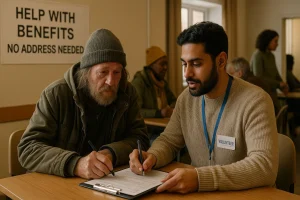
Homeless individuals are still entitled to claim benefits in the UK, even without a permanent address.
The benefits system recognises that people experiencing homelessness often face barriers that prevent them from providing standard documentation.
As long as they can provide an accessible correspondence address, their claim can proceed.
Acceptable address options include:
- A day centre or homeless charity
- A hostel or temporary accommodation
- A Jobcentre Plus office
- The address of a trusted friend or relative
Using one of these options enables the Department for Work and Pensions to send letters, appointment notifications and claim updates.
Many support organisations also help homeless people choose the most suitable address and assist in completing the application forms.
This process ensures that individuals without stable accommodation are not excluded from financial support.
Support workers frequently guide claimants in providing alternative evidence if they do not possess standard identification.
Jobcentres can verify identity through interviews or supporting statements, allowing applications to continue without delay.
Can Homeless Individuals Receive Benefits Without A Bank Account?
A bank account is not mandatory to receive benefits. Several alternatives allow claimants without banking access to receive payments safely and consistently.
This is particularly important for rough sleepers and those who have lost their documents.
There are two common options:
- Payment into the bank account of a trusted person
- Use of the Payment Exception Service, allowing claimants to collect benefit payments in person at authorised outlets
The Payment Exception Service issues a code that can be used at designated PayPoint retailers or Post Offices.
This is particularly useful for people who may not have secure storage for bank cards or paperwork.
Many banks also offer basic accounts that can be opened with limited proof of identity. Homeless charities often issue letters confirming an individual’s circumstances, allowing banks to accept the application.
Jobcentre Plus staff also provide guidance on opening an account with minimal documentation.
What Types Of Benefits Are Available To Homeless People In The UK?
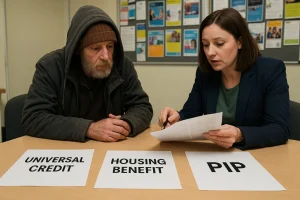
Homeless individuals may qualify for several different benefits depending on their age, health, living arrangements and personal circumstances.
These benefits are designed to support basic living needs, provide financial stability and help individuals move towards more secure housing.
Understanding each benefit and how it applies to homelessness is essential for making an accurate and successful claim.
Below is a detailed breakdown of the main benefits available.
Universal Credit
Universal Credit is the primary financial support for people who are unemployed or on a low income.
It replaces several older benefits and combines them into a single payment. For homeless individuals, Universal Credit can be particularly significant because it can include help with housing costs.
Key features include:
- Monthly payment structure
- Additional amounts for children, disabilities or housing
- Eligibility even without a fixed address
Claimants must complete an online application and may need support from organisations to provide alternative forms of identification or addresses.
Housing Benefit
Housing Benefit provides support with rent, but it only applies in certain situations. It is primarily available to people living in:
- Emergency accommodation
- Supported accommodation
- Temporary housing provided by local authorities
Most young people receive the shared accommodation rate unless they meet specific exemption criteria.
The payment amount varies based on Local Housing Allowance rates. For individuals on Universal Credit, the housing element usually replaces Housing Benefit unless they live in qualifying accommodation.
Child Benefit
Child Benefit is available to parents or guardians with dependent children. Homeless individuals with children can claim the benefit as long as they meet the general eligibility conditions.
It provides regular payments that help with the cost of raising children and is usually paid every four weeks.
Claimants do not need to be in stable housing to receive Child Benefit, making it an essential support option for families in temporary or unsettled situations.
Personal Independence Payment
Personal Independence Payment is designed for people with long term physical or mental health conditions. It is not means tested, which means income and savings do not affect eligibility. Homeless individuals may qualify if their condition affects daily living tasks or mobility.
The application involves a detailed questionnaire and an assessment. Support from charities and health professionals can make the process easier, especially for those without access to medical records or stable accommodation.
Employment And Support Allowance
Employment and Support Allowance offers financial support for people whose ability to work is limited by illness or disability.
Homeless individuals with health conditions may be able to claim ESA alongside or instead of Universal Credit, depending on their circumstances.
A work capability assessment determines the level of support. Those placed in the support group are not required to look for work.
Those in the work related activity group work with advisers to improve employment prospects when appropriate.
How Can Someone Who Is Homeless Apply For Universal Credit?
Universal Credit is the primary benefit available to most homeless adults. It can include housing costs, which is essential for those seeking long term accommodation.
Applications can still be made without standard documentation, although alternative evidence may be required.
Applicants usually need:
- A correspondence address
- An email address
- A phone number
- Identification, such as a passport or driving licence
If identification is missing, applicants can contact the Universal Credit helpline or speak to Jobcentre Plus staff for verification support.
It is common for support workers to help individuals set up an email account, gather necessary documents or attend appointments.
Universal Credit may include higher payments for individuals with disabilities, health conditions or childcare responsibilities.
Claimants sleeping rough may receive lower housing elements, depending on their living situation.
Is Housing Benefit Available For Rough Sleepers Or Temporary Accommodation?
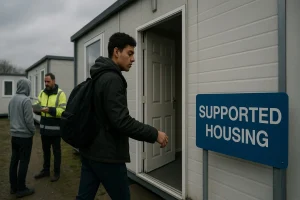
Housing Benefit remains available to individuals in specific types of accommodation, particularly those in emergency or supported housing.
This benefit is essential for young people and vulnerable adults who rely on temporary placements.
Most individuals under 35 receive the shared accommodation rate, although exceptions apply for certain groups such as care leavers or those fleeing abuse. The amount awarded depends on Local Housing Allowance rates in the claimant’s area.
Housing Benefit is usually applied for through the local council. For individuals receiving Universal Credit, the housing element replaces Housing Benefit in most circumstances.
Support workers can help applicants gather proof of accommodation and complete the claim forms.
What Support Is Available For Homeless People With Children?
Homeless individuals responsible for children may qualify for additional financial support. Universal Credit provides a child element, which increases depending on the number and age of children.
Parents or guardians can also claim Child Benefit, a payment designed to help with the costs of raising children.
This is available whether the claimant is employed, unemployed or homeless, as long as they meet the eligibility criteria. Payments are normally received every four weeks, although weekly payments may be possible for those on low incomes.
Children’s services and housing officers often work together to ensure families receive the correct level of support and access safe accommodation.
Can Homeless Individuals Claim Personal Independence Payment?
Personal Independence Payment supports individuals with long term physical or mental health conditions.
It is not based on income and can be claimed whether the individual is working, unemployed or homeless.
Eligibility is based on:
- Difficulty performing daily living tasks
- Difficulty moving around or travelling independently
The assessment includes questions about how a person’s condition affects their daily activities rather than the diagnosis itself.
Applying for PIP can be a lengthy process that involves completing forms and attending an assessment.
Support workers often assist by helping individuals gather medical evidence and complete the required paperwork. PIP payments can significantly increase overall income and may entitle claimants to additional support.
What Help Is Available For Homeless People With Health Conditions Or Disabilities?
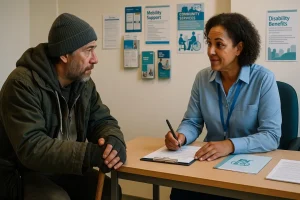
Employment and Support Allowance provides financial help for those who cannot work due to a health condition or disability. It may be claimed alongside Universal Credit in some situations.
Claimants undergo a work capability assessment to determine the level of support needed. Those placed in the support group are not required to look for work.
Those in the work related activity group may need to attend appointments designed to help them move closer to employment.
ESA applications can be made online or through Jobcentre Plus. Individuals experiencing homelessness often receive guidance from support workers or charity advisers throughout the process.
Are There Emergency Financial Supports For Homeless Individuals?
Emergency financial help is available for people who cannot meet essential living costs. These supports provide short term relief and can prevent further hardship.
| Type of Support | Purpose | Repayment Required |
| Universal Credit Advance | Covers gap before first payment | Yes |
| Budgeting Advance | Helps with essential items such as clothing or food | Yes |
| Discretionary Housing Payment | Assists with rent shortfalls, deposits or rent in advance | No |
| Hardship Payment | Helps during benefit sanctions | Yes |
These payments are often arranged through the Jobcentre or local authority. Support workers commonly assist with the applications to ensure individuals receive funds as quickly as possible.
How Can Grants Help People Facing Homelessness?
Grants provide vital support for individuals who need help with specific expenses. Because grants do not need to be repaid, they are particularly valuable for people transitioning out of homelessness.
Grants may cover:
- Household items
- Clothing
- Energy bills
- Work related equipment
Eligibility varies depending on the organisation providing the grant. Many require evidence of need, and support workers commonly help applicants prepare the necessary information.
Grants can also bridge the financial gap while individuals wait for benefit payments to be processed.
Why Is Budgeting Important For Those Receiving Benefits?

Budgeting skills help individuals manage irregular or limited income. This is especially important for people moving from homelessness into longer term accommodation, where new responsibilities such as rent, utilities and council tax may apply.
Key benefits of budgeting include:
- Understanding essential expenses
- Planning for emergencies
- Managing benefit payment cycles
- Avoiding arrears and sanctions
Money management programmes teach individuals how to create budgets, prioritise bills and develop sustainable financial habits. These skills provide long term stability and support the transition into independent living.
Conclusion
Homelessness does not disqualify a person from accessing the UK’s welfare system. From Universal Credit and Housing Benefit to emergency grants and personal disability payments, a wide range of support is available.
While the process may feel overwhelming, numerous organizations, from local authorities to national charities, are ready to guide individuals through the system.
The most important step is to reach out and begin the process. Help is available, and financial support can be the first step toward stability, independence, and recovery.
FAQs
What documents do I need to claim benefits if I’m homeless?
Applicants typically need identification, contact information, and a usable address. Support services can help if documents are missing.
How long does it take to receive Universal Credit when homeless?
It can take up to five weeks. Advance payments are available in emergencies.
Can I get help setting up a bank account if I’m homeless?
Yes, many charities and Jobcentre staff can help set up a basic account, even without proof of address.
What happens if my benefits are sanctioned?
You may be eligible for a Hardship Payment to cover essentials while your benefits are temporarily reduced.
Are there any benefits for young homeless people?
Young people may be eligible for shared accommodation rates, Child Benefit (if they have children), and Universal Credit with tailored support.
Can I apply for benefits without internet access?
Yes, Jobcentres can assist, and applications can also be made via phone or with help from support agencies.
Where can I get help filling out benefit forms?
Citizens Advice, local councils, and homeless charities like Centrepoint offer guidance and form-filling support.