The UK housing market has entered another period of uncertainty as Nationwide’s latest House Price Index reveals that annual property price growth slowed to just 0.5% in October 2026, its weakest rate since January 2024.
The slowdown follows annual growth of 0.8% in September, with average UK property prices reaching £273,566 in October, compared with £274,251 the previous month.
Although these figures suggest a weakening property market, they do not indicate a nationwide annual house price crash. Instead, prices remained effectively unchanged on a seasonally adjusted monthly basis, while annual growth continued to lose momentum.
Higher mortgage rates, inflation concerns, geopolitical tensions and falling consumer confidence are placing increasing pressure on buyers and sellers.
Our analysis of the latest housing figures highlights an important shift: mortgage affordability and buyer confidence are becoming more influential than the traditional expectation that UK house prices will continue rising.
For first-time buyers, existing homeowners, landlords and property investors, the latest Nationwide UK property price drop figures raise questions about whether further declines could emerge before the market recovers.
What Does the Latest Nationwide UK Property Price Drop Report Reveal?
The Nationwide October 2026 House Price Index shows that the UK property market continued losing momentum despite avoiding a significant monthly decline.
Nationwide recorded the weakest annual growth since January 2024, reflecting a combination of higher borrowing costs and weaker housing demand.
Nationwide House Price Index: October 2026 vs September 2026
| Property Market Indicator | October 2026 | September 2026 |
| Average UK house price | £273,566 | £274,251 |
| Annual house price growth | 0.5% | 0.8% |
| Monthly price movement | -0.0% | -0.3% |
| Seasonally adjusted index | 547.8 | 548.1 |
| Annual growth trend | Slowing | Slowing |
Source: Nationwide Building Society. Monthly changes and index figures are seasonally adjusted; average prices are not seasonally adjusted.
The average property price was £685 lower in October than in September, representing approximately a 0.25% reduction in the unadjusted average.
However, this should not be confused with Nationwide’s official monthly growth measure, which was effectively flat after seasonal adjustment.
The distinction matters because the housing market naturally experiences seasonal fluctuations. Nationwide adjusts its monthly index to identify the underlying direction of property values rather than treating every seasonal movement as evidence of falling demand.
The latest figures suggest that the market is stagnating rather than experiencing a sudden national collapse. Nevertheless, slowing annual growth leaves property prices more vulnerable if mortgage costs remain elevated or economic confidence deteriorates further.
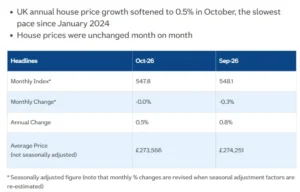
Nationwide’s October 2026 House Price Index confirms that annual UK house price growth slowed to 0.5%, with monthly prices remaining effectively unchanged.
Are UK House Prices Actually Falling in October 2026?
UK property prices are showing signs of weakness, but the Nationwide figures do not establish that house values are falling across the country.
Annual growth remains positive at 0.5%, meaning the typical property is still worth slightly more than it was a year earlier according to Nationwide’s index.
However, falling growth rates can indicate the beginning of a more challenging period.
There are three important differences:
- Slowing growth: Property prices continue rising, but more slowly than previously.
- Monthly price decline: Property values decrease compared with the preceding month.
- Annual price decline: Property values fall below their level in the same month a year earlier.
Our assessment is that the latest figures point towards stagnation with downside risks, particularly because mortgage affordability has deteriorated while buyer enquiries remain weak.
Earlier UK summer property sales data also indicated weakening buyer interest and fewer agreed transactions.
These developments suggest that October’s slowdown is part of a broader market trend rather than an isolated monthly fluctuation.
Why Is the UK Property Market Slowing Down in 2026?
Several economic pressures are contributing to weaker housing demand.
Higher Mortgage Costs and Inflation
Mortgage rates have increased as financial markets anticipate tighter monetary policy.
The Bank of England maintained Bank Rate at 3.75% in September 2026, but investors have increasingly expected a potential increase because of persistent inflation pressures.
Higher energy prices linked to geopolitical tensions have contributed to these expectations.
Nationwide Chief Economist Robert Gardner explained that rising energy costs and inflation concerns were maintaining upward pressure on the market interest rates used to price mortgages.
The result is that potential buyers face more expensive borrowing even though the Bank of England has not yet increased its official rate.
Weaker Buyer Demand
Housing demand has also softened as households become more cautious about major financial commitments.
Buyers are increasingly considering:
- Whether their employment and income remain secure.
- How mortgage repayments could change after refinancing.
- Whether property asking prices reflect current affordability.
- Whether delaying a purchase might provide better negotiating opportunities.
This caution can lengthen selling periods and encourage vendors to reconsider ambitious valuations.
The pattern is consistent with Rightmove’s August property market figures, which showed increased pressure on asking prices during the summer.
How Are Rising Mortgage Rates Affecting UK House Prices?
Mortgage affordability is central to understanding the Nationwide UK property price slowdown.
According to the latest reporting, Moneyfacts recorded an average five-year fixed mortgage rate of 5.99% on 29 October, while the two-year average reached 5.97%.
The Guardian+1
A higher mortgage rate directly reduces the amount many households can comfortably borrow.
For example, the following calculations illustrate repayments on a £200,000 repayment mortgage over 25 years.
| Mortgage Interest Rate | Approximate Monthly Repayment |
| 4.5% | £1,112 |
| 5.0% | £1,169 |
| 5.5% | £1,228 |
| 6.0% | £1,289 |
| 6.5% | £1,350 |
Illustrative calculations based on a £200,000 capital-and-interest mortgage over 25 years, excluding fees.
Moving from a 5% mortgage to a 6% mortgage increases repayments by approximately £120 per month.
That represents roughly £1,440 in additional annual expenditure without changing the property purchase price.
For households already managing rising energy, transport and living costs, this additional burden can significantly affect affordability.
Tom Bill, Head of UK Residential Research at Knight Frank, observed that rising mortgage costs were outweighing the benefits of recently announced housing support measures.
His assessment also highlighted the need for asking prices to reflect buyers’ more difficult financial circumstances.
What Does Falling UK Consumer Confidence Mean for Property Prices?
Consumer confidence has become another important indicator of housing market performance.
Nationwide’s October report includes GfK consumer confidence measures tracking expectations for personal finances and the wider economy.
The latest chart shows that households have become less optimistic about both their future financial circumstances and the general economic outlook.
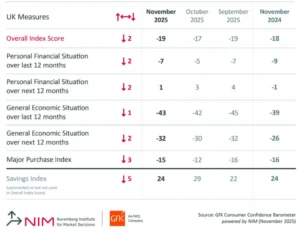
UK consumer confidence weakens in October 2026 as households become more cautious about their financial outlook.
A decline in confidence does not automatically cause house prices to fall. However, it can lead households to postpone property purchases, particularly when mortgage costs are elevated.
For sellers, weaker confidence may mean fewer viewings, longer marketing periods and more negotiation over asking prices.
Gardner warned that forward-looking housing indicators suggested further near-term softness, noting weak enquiries from prospective buyers.
Are UK Homes Becoming Less Affordable for First-Time Buyers?
Affordability remains difficult, although the underlying picture is more balanced than mortgage rates alone suggest.
Nationwide’s research indicates that average earnings have grown faster than property prices over the past two years.
This has helped improve the relationship between household incomes and housing costs.
However, recent increases in mortgage rates have partially reversed those gains.
First-time buyer mortgage payments as a percentage of take-home pay, with long-run average and mortgage-rate scenarios. Source: Nationwide, UKF and ONS.
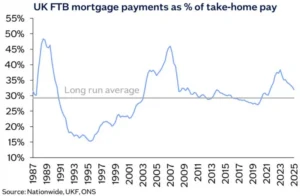
Caption: Nationwide’s affordability analysis shows that typical first-time buyer mortgage payments remain above their long-run share of take-home pay.
The chart indicates that first-time buyer mortgage repayments represent roughly one-third of take-home pay, compared with a long-run average close to 30%.
This creates an important distinction between property prices becoming more affordable relative to earnings and mortgages becoming easier to repay.
Buyers should therefore examine total monthly housing expenditure rather than focusing exclusively on purchase prices.
Available government support options for first-time buyers may help with deposits, although eligibility and current scheme terms should be checked carefully.
What Does the Nationwide Price Slowdown Mean for Home Sellers?
Sellers may need to adopt more realistic expectations as housing demand weakens.
A property priced according to stronger market conditions could struggle to attract offers when potential purchasers face tighter mortgage affordability.
Our analysis suggests that sellers should concentrate on comparable completed transactions rather than relying solely on advertised prices.
Practical considerations include:
- Comparing recent local sales involving similar property types.
- Reviewing competing properties currently available.
- Assessing whether the asking price reflects the home’s condition and energy efficiency.
- Considering the financial implications of a longer selling period.
- Remaining open to credible offers from mortgage-approved buyers.
Automated valuations, including Zoopla’s house price estimates, can provide useful starting points, but they should not replace local market evidence.
Jason Tebb, President of OnTheMarket, commented in response to October’s figures that buyers proceeding with transactions were increasingly price-sensitive and negotiating firmly.
Financial Reporter
This suggests sellers who respond quickly to market feedback may be better positioned to secure transactions than those maintaining unrealistic valuations.
Could the Nationwide UK Property Price Drop Continue Into 2027?
The near-term housing outlook remains uncertain, with several indicators suggesting that prices could experience further pressure.
Nationwide has identified weak buyer enquiries, deteriorating consumer sentiment and higher mortgage costs as reasons for caution.
However, it has also highlighted resilient employment, improving real incomes and relatively healthy household balance sheets as potential foundations for recovery.
The next Bank of England monetary policy decision is scheduled for 5 November 2026.
Any increase in Bank Rate could influence variable-rate borrowers immediately or over time, depending on their mortgage terms. Fixed-rate mortgage pricing, meanwhile, also depends on expectations already reflected in wholesale financial markets.
Three broad housing market scenarios appear possible:
| Scenario | Potential Effect on UK Property Prices |
| Mortgage rates remain elevated | Continued stagnation or modest price declines |
| Energy inflation eases and borrowing costs stabilise | Gradual recovery in demand and annual growth |
| Inflation rises further and mortgage rates increase | Greater affordability pressure and weaker prices |
These are possible scenarios rather than confirmed forecasts.
Rob Wood, Chief UK Economist at Pantheon Macroeconomics, suggested that new first-time buyer support could provide a modest market boost, although he expected property prices to remain subdued in 2027.
The timing and strength of any recovery will depend heavily on mortgage pricing and household purchasing power.
Will All UK Regions Experience the Same Property Price Drop?
National house price figures can conceal substantial differences between regional markets.
Housing demand varies according to employment opportunities, local earnings, property availability, transport connections and the proportion of buyers requiring mortgages.
For example, earlier Nationwide regional data for the third quarter of 2026 showed Northern Ireland recording comparatively strong annual growth of 5.9%, while East Anglia experienced a 0.7% annual decline.
These figures demonstrate that a weak national market does not necessarily mean every region is experiencing falling prices.
Home
Property type also matters. Flats, family houses and larger detached properties may experience different demand patterns.
Buyers and investors should therefore avoid applying the national 0.5% annual growth figure directly to individual properties.
A local valuation supported by recent sales evidence remains more useful for estimating a home’s likely transaction price.
How Could Falling House Prices Affect UK Landlords and Property Investors?
Landlords face a different financial calculation from owner-occupiers.
While weaker property prices may create acquisition opportunities, higher borrowing costs can reduce investment returns.
Investors need to assess rental income against mortgage interest, maintenance, insurance, taxation and potential vacant periods.
Recent evidence of landlords keeping rent prices unchanged also illustrates how some property owners are prioritising tenant retention rather than maximising short-term rental increases.
For leveraged investors, declining property values can affect refinancing options and loan-to-value ratios.
However, lower purchase prices may improve gross rental yields where rents remain stable.
The investment decision should therefore depend on sustainable cash flow and local rental demand, rather than assumptions that capital values will automatically recover.
Is Now a Good Time to Buy a Property in the UK?
The Nationwide slowdown could create opportunities for buyers who have stable incomes, adequate deposits and access to affordable mortgage products.
However, delaying a purchase solely because national prices might fall further carries risks.
Mortgage rates could rise even if property prices decline, potentially offsetting any purchase-price saving.
Buyers should consider the following conditions before proceeding:
- The property meets their medium- to long-term housing requirements.
- Mortgage repayments remain manageable under reasonable financial stress scenarios.
- Sufficient savings remain available after deposit and transaction costs.
- The asking price is supported by recent comparable sales.
- Their expected ownership period reduces the risk of needing to sell during temporary market weakness.
For first-time buyers in particular, the total cost of ownership should remain more important than predicting the exact bottom of the housing market.
FAQs About Nationwide UK Property Price Drop
Are UK house prices falling according to Nationwide?
Nationwide reported annual growth of 0.5% in October 2026, while monthly prices remained effectively flat after seasonal adjustment. The figures indicate slowing growth rather than a nationwide annual decline.
What was the average UK house price in October 2026?
The average UK property price was £273,566, compared with £274,251 in September, according to Nationwide’s October House Price Index.
Why are UK property prices slowing down?
Higher mortgage costs, inflation concerns, weaker buyer demand and declining consumer confidence are contributing to slower housing market activity.
Will UK house prices drop further in 2027?
Further declines are possible if mortgage costs remain elevated and demand stays weak. However, stronger incomes and easing inflation could help support a gradual recovery.
Is the UK housing market going to crash?
Nationwide’s October data does not establish an impending housing market crash. It shows annual growth remaining positive, although economic uncertainty has increased the risk of further weakness.
Should first-time buyers wait for house prices to fall?
Waiting may provide better prices in some locations, but mortgage rates could also increase. Buyers should compare affordability, deposit requirements and local valuations before deciding.
How do higher mortgage rates affect house prices?
Higher mortgage rates increase monthly repayments and can reduce borrowing capacity. This can weaken housing demand, encourage price negotiations and place downward pressure on property values.