Last Updated On – 10-09-2026
A buy-to-let interest-only mortgage allows a landlord to pay only the interest charged on the mortgage each month rather than repaying the original loan at the same time. This keeps monthly mortgage payments lower, but the full capital balance remains outstanding and must be repaid when the mortgage term ends.
Interest-only remains common in the buy-to-let market because landlords may prioritise rental cash flow. However, it is not automatically cheaper overall. Investors need to consider interest rates, rental coverage, tax, mortgage fees and how the outstanding capital will eventually be repaid.
UK Finance reported that the average interest rate across new UK buy-to-let lending was 4.71% in Q1 2026, while the average gross rental yield was 7.21%.
Last Updated: 10.09.2026
What Is a Buy-to-Let Interest-Only Mortgage?
A buy-to-let interest-only mortgage is specifically used to finance a property that will normally be rented to tenants.
The mortgage consists of two main parts:
- Capital: The amount borrowed from the lender
- Interest: The charge for borrowing that money
With an interest-only mortgage, the monthly payment normally covers only the interest. The capital does not automatically reduce.
For example, if a landlord borrows £180,000 on an interest-only basis, they could still owe £180,000 when the mortgage term ends, assuming they have not made capital repayments.
This differs from a repayment mortgage, where every monthly payment includes interest plus some repayment of the original borrowing.
Most buy-to-let mortgages are commonly arranged on an interest-only basis, although repayment options are also available.
MoneyHelper notes that interest-only borrowing is particularly common in buy-to-let because it reduces monthly outgoings, but borrowers need a credible way of clearing the capital.
How Does A Buy-to-Let Interest-Only Mortgage Work?
The landlord purchases a rental property using a deposit and mortgage.
Suppose a property costs £250,000 and the landlord contributes a 25% deposit of £62,500.
The mortgage would be:
£250,000 – £62,500 = £187,500
If the mortgage rate were 5%, the annual interest would initially be:
£187,500 × 5% = £9,375
That produces an illustrative monthly interest payment of approximately:
£781.25
The landlord may receive rent from the property and use some of it to cover the mortgage, maintenance, insurance, letting costs, tax and other expenses.
The important point is that paying £781.25 each month would not reduce the £187,500 mortgage balance if the loan remained entirely interest-only.
The investor therefore needs a separate strategy for clearing that balance later.

Buy To Let Interest-Only Mortgage Rates In 2026
Buy-to-let mortgage rates vary considerably between lenders and products.
The rate offered to an individual landlord can depend on:
- Loan-To-Value: A larger deposit can provide access to lower LTV products
- Rental Income: Lenders assess whether expected rent adequately covers borrowing costs
- Fixed Period: Two-year and five-year deals may be priced differently
- Property Type: HMOs, flats and specialist properties can have different criteria
- Borrower Type: Personal and limited-company borrowers may have different products
- Portfolio Size: Larger landlords can face additional underwriting
- Fees: A low headline rate can come with a substantial arrangement fee
UK Finance recorded an average rate of 4.71% across new buy-to-let loans in Q1 2026, down from 5.00% a year earlier.
Landlords should therefore avoid comparing deals solely by headline interest rate. Product fees, valuation charges, early repayment charges and the rate that applies after the initial deal ends can materially change the total cost.
How Much Deposit And Rental Income Do You Need?
Buy-to-let mortgages generally require a larger deposit than standard residential borrowing.
A 25% deposit, giving a mortgage at 75% loan-to-value, is a common starting point. Some higher-LTV products exist, while landlords with larger deposits may have access to a broader range of deals.
MoneyHelper states that borrowers will generally need at least around 25% deposit or equity, although individual lender requirements vary.
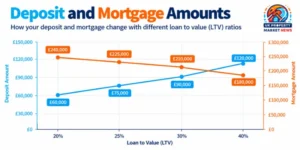
For a £300,000 property, the figures would look like this:
| Deposit | Deposit Amount | Mortgage | LTV |
| 20% | £60,000 | £240,000 | 80% |
| 25% | £75,000 | £225,000 | 75% |
| 30% | £90,000 | £210,000 | 70% |
| 40% | £120,000 | £180,000 | 60% |
A larger deposit reduces the amount borrowed, but investors also need to consider whether using more cash for one purchase affects their ability to fund maintenance, tax or future acquisitions.
Loan-To-Value Requirements
Loan-to-value measures the mortgage against the property’s value.
The calculation is:
Mortgage ÷ Property Value × 100 = LTV
A £225,000 mortgage secured against a £300,000 property gives a 75% LTV.
Lower LTV generally reduces the lender’s exposure and may improve the range of mortgage products available.
Interest Coverage Ratio And Stress Testing
Buy-to-let affordability is not assessed in exactly the same way as a normal residential mortgage.
Expected rent plays an important role.
One common measure is the Interest Coverage Ratio, or ICR:
Monthly Rental Income ÷ Monthly Mortgage Interest × 100
The Prudential Regulation Authority expects relevant lenders to assess whether rental income can support mortgage interest and to allow for potential future interest-rate increases in affordability testing.
Individual lender requirements vary, but rental coverage of around 125% to 145% is commonly encountered.
If the stressed mortgage interest were £800:
- 125% Coverage: £1,000 monthly rent
- 140% Coverage: £1,120 monthly rent
- 145% Coverage: £1,160 monthly rent
The actual calculation may use a lender’s stress rate rather than the interest rate shown on the mortgage deal.
That means a property producing enough rent to cover the actual payment may still fail a lender’s affordability assessment.
Interest Only Vs Repayment Buy To Let Mortgage
The main difference is what happens to the mortgage capital.
An interest-only mortgage keeps monthly payments lower but leaves the capital outstanding. A repayment mortgage costs more each month because the borrower gradually reduces the loan.
Consider a £187,500 mortgage over 25 years at an illustrative constant rate of 5%.
| Comparison | Interest Only | Repayment |
| Approximate Monthly Payment | £781 | £1,096 |
| Capital Reduced Monthly | No | Yes |
| Balance At End Of Term | £187,500 | £0 |
| Approximate Total Interest | £234,375 | £141,332 |
These figures are illustrative and assume the rate remains at 5% for the entire 25 years.
The interest-only option provides roughly £315 more monthly cash flow in this example. However, the landlord remains responsible for the £187,500 capital balance.
Worked Monthly Payment Example
Suppose the same property generates £1,400 rent per month.
Before other landlord expenses:
Interest Only
£1,400 rent – £781 mortgage interest = £619
Repayment
£1,400 rent – £1,096 mortgage payment = £304
Interest-only therefore creates more immediate cash flow.
But neither figure represents actual landlord profit. Investors still need to account for costs such as:
- Letting Agent Fees
- Insurance
- Repairs And Maintenance
- Safety And Compliance Costs
- Service Charges Where Applicable
- Periods Without A Tenant
- Tax
This is why mortgage payment alone should never be used to judge whether a rental property is profitable.
Pros And Cons Of An Interest Only Buy-To-Let Mortgage
Interest-only borrowing can support cash flow, particularly for landlords building a portfolio, but it also increases long-term financial responsibility.
| Advantages | Disadvantages |
| Lower Monthly Mortgage Payments | Capital Does Not Automatically Reduce |
| More Rental Cash Flow Available | Full Loan Remains Due At The End |
| More Flexibility For Other Property Costs | Higher Lifetime Interest Can Result |
| Cash May Be Available For Further Investment | Refinancing Is Not Guaranteed |
| Can Improve Short-Term Cash Flow | Property Prices Can Fall |
Interest-only can make sense when the landlord has deliberately chosen lower monthly repayments as part of a wider investment strategy.
It is much riskier when there is no realistic plan for clearing the capital.
How Have Buy To Let Mortgage Rates Changed Over The Years?
The financing environment for landlords has changed substantially since 2021.
2021–2022: End Of Ultra-Low Rates
- Bank Rate remained as low as 0.1% during much of 2021 before the Bank of England began increasing rates in December that year.
- Those rises accelerated throughout 2022 as inflation increased.
2022–2024: Higher Borrowing Costs
- Bank Rate reached 5.25% in August 2023, having risen from 0.1% since December 2021. It remained at 5.25% until reductions began in August 2024.
- Higher borrowing costs put particular pressure on interest-only landlords because the monthly payment directly reflects interest charged on a large outstanding capital balance.
2025–2026: Rates Begin To Ease
- Bank Rate continued moving lower through 2025 and stood at 3.75% in September 2026, ahead of the next Monetary Policy Committee decision scheduled for 17 September.
- UK Finance’s Q1 2026 data also showed the average rate on new buy-to-let lending had fallen year on year to 4.71%.
Future Outlook
Landlords should not assume mortgage rates will continue falling.
Future pricing can be affected by inflation, Bank Rate expectations, government bond yields, lenders’ funding costs and competition between mortgage providers.
A viable investment should ideally remain manageable if refinancing costs turn out to be higher than expected.
Tax on Buy-to-Let Interest-Only Mortgages
Mortgage tax treatment is important because interest-only landlords can have substantial annual finance costs.
For individual landlords with residential property, mortgage interest is no longer simply deducted in full from rental income before Income Tax is calculated.
Instead, qualifying residential finance costs are generally subject to a basic-rate tax reduction under the finance cost restriction rules.
Section 24 Mortgage Interest Tax Relief
Consider a simplified landlord receiving:
- Annual Rent: £18,000
- Mortgage Interest: £9,000
- Other Allowable Expenses: £3,000
The tax calculation for an individual landlord is not simply based on £18,000 minus £9,000 minus £3,000.
The finance cost restriction means residential mortgage interest is treated separately when calculating the available basic-rate tax reduction.
This can have a greater impact on higher-rate taxpayers.
Tax calculations depend on individual circumstances, so landlords should use current HMRC rules and professional tax advice where necessary.
Personal Ownership Vs Limited Company
Some landlords purchase property through a limited company or special purpose vehicle.
Companies are not subject to the individual residential finance cost restriction in exactly the same way. However, that does not mean limited-company ownership is automatically cheaper.
Investors need to consider:
- Corporation Tax
- Mortgage Rates And Fees
- Accountancy Costs
- Company Administration
- How Profits Are Withdrawn
- Dividend Or Salary Tax Consequences
- Future Property Sale Tax Treatment
The correct ownership structure depends on the investor’s portfolio, income, long-term objectives and tax position.
How To Get A Buy To Let Interest Only Mortgage
Lenders have different criteria, but an application will normally involve several core checks.
- Work Out Your Deposit: Calculate the purchase price, available deposit and resulting LTV.
- Estimate Realistic Market Rent: Use achievable rental income rather than assuming the highest advertised rent in the area.
- Check Rental Coverage: Estimate whether rental income could meet lender ICR and stress-test requirements.
- Review Your Finances: Credit history, existing borrowing, personal income and other properties can affect lender decisions.
- Compare Total Mortgage Cost: Consider the rate, arrangement fee, valuation costs, early repayment charges and reversion rate.
- Prepare Supporting Information: Lenders may request identification, bank statements, income evidence, portfolio information and details of expected rental income.
- Decide How The Capital Will Be Repaid: A lower monthly payment should not distract from the fact that the original mortgage remains outstanding.
How Do You Repay An Interest Only Buy To Let Mortgage?
There is no automatic capital repayment built into a fully interest-only mortgage.
The landlord therefore needs an exit strategy.
Sell The Property
Selling is one possible way to repay the mortgage.
However, relying entirely on rising property prices creates risk. The property could be worth less than expected when the mortgage ends.
PRA guidance specifically says lenders should not base affordability assessments on assumed future increases in property prices.
Remortgage
A landlord may refinance onto another mortgage before or at the end of the term.
This is not guaranteed.
Eligibility at that point could depend on:
- Property Value
- Rental Income
- Interest Rates
- Lender Criteria
- Borrower Age
- Credit History
- Portfolio Performance
Make Capital Overpayments
Some landlords use excess rental cash flow to reduce the mortgage gradually.
Mortgage terms should be checked first because limits or early repayment charges can apply.
Reducing capital can lower future interest charges and decrease the amount that eventually needs to be refinanced or repaid.
Switch To Repayment
Another option is changing some or all of the mortgage to a repayment basis.
Monthly costs increase, but the outstanding balance begins falling.
Some landlords may also consider a combination where part of the mortgage remains interest-only and another part is repaid.
What Happens If You Cannot Repay At The End Of The Term?
An interest-only mortgage does not disappear when the agreed term ends.
If the outstanding capital cannot be repaid, the borrower should contact the lender as early as possible rather than waiting until the maturity date.
Possible outcomes may include refinancing, changing the repayment arrangement, selling the property or agreeing another solution with the lender.
There is no guarantee that a lender will extend the mortgage.
MoneyHelper recommends contacting a lender as soon as possible when an interest-only borrower cannot repay the capital because dealing with the issue earlier generally creates more options.
A robust repayment strategy should therefore consider what happens if:
- Property Prices Fall
- Mortgage Rates Rise
- Rental Income Drops
- The Property Is Empty
- Refinancing Criteria Tighten
- Unexpected Repairs Reduce Savings
Interest Only Or Repayment: Which Is Better For Landlords?
Neither mortgage structure is automatically better.
The right choice depends on what the landlord is trying to achieve.
| Landlord Priority | Interest Only | Repayment |
| Lower Monthly Payments | Stronger | Weaker |
| Maximising Immediate Cash Flow | Stronger | Weaker |
| Gradually Clearing Property Debt | Weaker | Stronger |
| Lower Total Interest Over Long Term | Usually Weaker | Usually Stronger |
| Growing A Property Portfolio | Can Offer Flexibility | Uses More Monthly Cash |
| Owning Property Mortgage-Free | Requires Separate Plan | Built Into Repayments |
| No Clear Exit Strategy | Higher Risk | Usually More Suitable |
Interest-only can work particularly well for landlords who understand cash flow, maintain financial reserves and have a credible capital repayment strategy.
A repayment mortgage may appeal more to an investor whose priority is steadily reducing leverage and eventually owning the rental property without mortgage debt.
The key comparison is not simply which has the lowest monthly payment.
Landlords should consider which structure produces the strongest position after five, ten or twenty-five years.
Conclusion
A buy-to-let interest-only mortgage can reduce monthly financing costs and leave landlords with more rental cash flow, which is one reason interest-only borrowing remains common in the UK rental market.
The trade-off is that the mortgage debt does not automatically decrease.
Before choosing interest-only, landlords should assess their deposit, LTV, expected rent, interest coverage ratio, tax position, mortgage fees and ability to cope with higher borrowing costs.
Most importantly, there should be a realistic plan for repaying the capital when the mortgage eventually ends.
Frequently Asked Questions
Are Most Buy To Let Mortgages Interest Only?
Interest-only mortgages are common in the buy-to-let sector because they offer lower monthly payments than equivalent repayment mortgages. Repayment buy-to-let mortgages are also available.
What Deposit Do You Need For An Interest Only Buy To Let Mortgage?
A deposit of around 25% is common, producing a 75% LTV mortgage, although requirements vary between lenders and some products allow higher or lower LTVs.
How Much Rent Do You Need To Qualify?
Many lenders expect rent to cover approximately 125% to 145% of stressed mortgage interest costs, although each lender sets its own affordability calculation.
Can First-Time Landlords Get An Interest Only Mortgage?
Yes. Some lenders accept first-time landlords, although eligibility can depend on income, credit history, deposit size, property type and expected rental income.
Can You Switch From Interest Only To Repayment?
Potentially. Existing borrowers can ask their lender whether changing repayment type is permitted. If not, remortgaging to another suitable product may be an alternative.
Can You Remortgage An Interest Only Buy To Let Property?
Yes, provided the landlord meets the new lender’s criteria. Rental coverage, property value, LTV, credit history and portfolio circumstances may all affect eligibility.