Landlords in Bath and North East Somerset could face significantly higher locally calculated financial penalties under a proposed tougher housing enforcement policy.
Bath & North East Somerset Council is consulting on an updated Housing Services Enforcement & Financial Penalty Policy 2026, which sets out how it intends to investigate housing-law breaches, enforce standards and determine financial penalties.
The consultation follows new duties and enforcement powers introduced through the Renters’ Rights Act 2025.
Under the proposals, some serious housing offences would have starting penalties of £20,000, while aggravating circumstances could increase the applicable starting figure by as much as 50%.
The council is also proposing adjustments based on factors such as landlord type, portfolio size and professional experience.
Importantly, these figures form part of a consultation proposal rather than a newly imposed blanket fine for Bath landlords. The consultation remains open until 23 September 2026.
What Is the Proposed Bath Landlord Fine Policy?
The Bath landlord fine policy is intended to establish a clearer framework for deciding when enforcement action should be taken and how financial penalties should be calculated.
Bath & North East Somerset Council says the updated policy could allow stronger action where there are serious hazards, illegal eviction, repeated non-compliance or licensing failures.
The changes come as councils across England take on stronger responsibilities under the Renters’ Rights Act. National statutory guidance now requires local housing authorities to develop and publish policies explaining how appropriate civil penalties will be determined.
The council’s proposal therefore matters not only to landlords already facing enforcement action, but also to landlords reviewing their compliance procedures following wider Renters’ Rights Act changes.
How Much Could Bath Landlords Be Fined?
The proposed policy contains different starting penalties depending on the nature and seriousness of the breach.
Based on the consultation information, some of the proposed starting points include:
| Housing breach | Proposed starting penalty |
| Failure to meet electrical safety standards under Regulation 3(1) | £12,000 |
| Failure to complete required electrical remedial work | £20,000 |
| Failure to provide an electrical report when requested | £12,000 |
| Serious HMO fire-standard breach | £20,000 |
| HMO over-occupation or insufficient amenities | £20,000 |
| Failure to provide certain safety certificates | £12,000 |
| Some documentation failures | £3,000 |
These are starting figures, not automatic penalties in every case. The eventual amount could change depending on aggravating and mitigating circumstances and would remain subject to the relevant statutory maximum.
For offences covered by current national civil-penalty guidance, the statutory maximum is generally £40,000 for an offence, while certain lower-level breaches carry a maximum civil penalty of £7,000.
Why Could Some Fines Rise by Up to 50%?
One of the most significant elements of the Bath landlord fine policy consultation is the proposed treatment of aggravating factors.
The council proposes applying increases where circumstances make an offence more serious. Each relevant aggravating factor could lead to an additional percentage being applied, with the combined aggravating-factor uplift capped at 50% of the applicable starting penalty.
Potential aggravating circumstances identified in the proposal include:
- Previous non-compliance.
- Failure to cooperate with council officers.
- Deliberate or reckless offending.
- Providing false or misleading information.
- A breach continuing for an extended period.
- The presence of serious Category 1 hazards.
- Actual harm caused to an occupant.
This reflects national guidance, which says councils should consider the seriousness of an offence, the offender’s culpability and track record, harm caused, deterrence and any financial benefit gained through non-compliance.
What Would a 50% Increase Mean?
If a breach had a starting penalty of £20,000, a full 50% aggravating-factor uplift would represent another £10,000, taking that element of the calculation to £30,000.
That does not mean every £20,000 starting penalty would automatically become £30,000. The council would have to assess the circumstances of the individual case and follow the final adopted policy and statutory limits.
Could Larger or Professional Landlords Pay More?
The consultation also proposes taking the landlord’s circumstances into account.
An upward adjustment of up to 20% could potentially apply based on factors including landlord type, experience, professional status and the size of the rental portfolio.
The criteria could capture landlords with:
- Six or more rental properties.
- Three or more HMOs.
- Corporate landlord structures.
- Evidence of significant professional knowledge or experience.
The rationale is that an experienced or large-scale landlord may reasonably be expected to have a greater understanding of housing legislation and compliance responsibilities.
National guidance also allows local authorities to consider whether a proposed penalty provides an adequate deterrent and whether reliable evidence of rental income, property assets or profit from offending justifies a higher figure.
Landlords operating shared accommodation may therefore want to pay particular attention to current HMO licensing rules, especially where fire safety, occupancy and amenity standards are concerned.
Can Mitigating Factors Reduce a Bath Landlord Fine?
Yes. The proposed Bath policy does not deal solely with increases.
Mitigating circumstances could reduce the calculated penalty by as much as 50%, depending on the circumstances.
Possible mitigating considerations include:
- Completing necessary remedial work within 28 days.
- Cooperating fully with the council.
- Admitting responsibility at an early stage.
- Self-reporting a breach.
- Having a strong previous compliance record.
The approach is intended to distinguish landlords who respond quickly and responsibly after discovering a problem from landlords who deliberately ignore their duties.
However, completing work after a breach has occurred does not necessarily mean enforcement action will disappear altogether.
National statutory guidance makes clear that councils can move directly to formal enforcement where appropriate and are not necessarily expected to issue an informal warning first.
Why Are Electrical and HMO Breaches Being Treated Seriously?
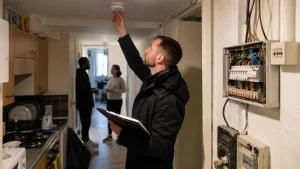
Electrical defects and failures involving fire precautions can create an immediate safety risk for occupants.
Under the proposed Bath framework, failing to undertake required electrical remedial work could therefore start at £20,000, while failure to comply with the underlying electrical safety standards could start at £12,000.
Serious breaches of HMO licence conditions involving measures such as:
- Fire alarms.
- Fire doors.
- Emergency lighting.
- Occupancy levels.
- Adequate amenities.
could also attract starting penalties of £20,000.
Landlords should therefore treat record keeping, inspections, repairs and safety certification as core compliance responsibilities rather than administrative formalities. A structured landlord compliance checklist can help property owners keep important obligations under review.
What Has Bath & North East Somerset Council Said?
Councillor Matt McCabe, the council’s Cabinet Member for Built Environment, Housing and Sustainable Development, said the purpose of the policy is to support safe housing while ensuring enforcement is proportionate.
He said the majority of landlords in Bath and North East Somerset provide good-quality accommodation and that the policy is intended to give landlords clearer guidance about how the council will use its enforcement powers.
The council says the Renters’ Rights Act has given local authorities an important role in protecting tenants and raising standards in the private rented sector, with the proposed policy designed to make enforcement fair, transparent and proportionate.
How Has the Renters’ Rights Act Changed Council Enforcement?
The Renters’ Rights Act 2025 significantly expanded enforcement arrangements in England.
Government statutory guidance distinguishes between a breach, for which certain civil penalties can reach £7,000, and an offence, where a local authority can in relevant circumstances prosecute or impose a financial penalty of up to £40,000.
From 1 May 2026, the expanded framework covers areas including:
- Certain tenancy-system violations.
- Unlawful eviction and harassment.
- HMO and selective licensing offences.
- Failure to comply with improvement notices.
- Overcrowding offences.
- Rental discrimination.
- Illegal rental bidding practices.
- Certain repeat or continuing breaches.
Local housing authorities are also under a statutory duty to enforce relevant landlord legislation and must consider government guidance when establishing their penalty policies.
Multiple civil penalties can potentially be imposed where several separate breaches or offences have occurred, including different failures involving the same property.
Can Landlords Challenge a Financial Penalty?
A landlord does have procedural protections when a council decides to impose a civil penalty.
Government guidance says a local authority must normally first issue a notice of intent, setting out the proposed amount, reasons for the penalty and information about the right to make representations.
The recipient generally has 28 days to make written representations.
If the council then proceeds with the penalty, it must issue a final notice. A landlord or other liable person can appeal a final civil penalty to the First-tier Tribunal (Property Chamber) within 28 days.
The Tribunal may confirm, reduce, increase or cancel the penalty, although any increase remains subject to the relevant statutory maximum.
What Should Bath Landlords Do Now?
Because the policy remains under consultation, landlords should not assume that every proposed starting figure or adjustment will necessarily be adopted unchanged.
However, the direction of travel is clear: local authorities have stronger enforcement duties, and serious or repeated non-compliance can carry substantial financial consequences.
Landlords in Bath and North East Somerset should consider reviewing:
- Electrical inspection reports and outstanding remedial work.
- Gas and other required safety documentation.
- HMO licence conditions.
- Fire doors, alarms and emergency lighting.
- Property occupancy limits.
- Required amenities.
- Tenancy documentation.
- Records of repairs and communications.
- Procedures for responding to council enquiries.
Keeping documented evidence of inspections, repairs and communication can also be important where a landlord later needs to demonstrate cooperation or establish the circumstances surrounding an alleged breach.
When Does the Bath Landlord Policy Consultation End?
Bath & North East Somerset Council’s Housing Services Enforcement and Financial Penalty Policy consultation runs until 23 September 2026. The council has invited responses from landlords, tenants, letting agents and residents before the policy is finalised.
Until that process is completed, the proposed starting penalties and percentage adjustments should be described as consultation proposals, not as finalised new Bath landlord fines.
Conclusion
The proposed Bath landlord fine policy signals a tougher and more structured approach to housing enforcement in Bath and North East Somerset.
Serious electrical safety, HMO fire-safety and occupancy failures could begin with penalties as high as £20,000, while aggravating circumstances could increase the applicable starting penalty by up to 50%.
At the same time, cooperation, early remedial work and a strong compliance history could reduce penalties.
With councils now carrying wider enforcement responsibilities under the Renters’ Rights Act, landlords have a stronger incentive to identify and correct compliance problems before they escalate into formal enforcement action.
FAQs
How much could Bath landlords be fined under the proposed policy?
Serious breaches such as failing to complete electrical remedial work or major HMO safety failures could start with penalties of £20,000.
Can Bath landlord fines increase above the starting amount?
Yes. Aggravating factors could increase the applicable starting penalty by up to 50%, subject to statutory limits.
What could make a landlord penalty higher?
Previous non-compliance, deliberate breaches, failure to cooperate, misleading information, serious hazards or actual harm to tenants could increase the penalty.
Can landlords receive a lower financial penalty?
Yes. Cooperation, early admission, prompt remedial work, self-reporting and a good compliance history could reduce a proposed penalty by up to 50%.
When does the Bath landlord fine policy consultation close?
Bath & North East Somerset Council’s consultation is scheduled to close on 23 September 2026, after which the final policy may differ from the current proposals.