In the warmer months, many UK homeowners seek ways to maintain a comfortable indoor temperature without relying heavily on air conditioning or expensive cooling systems.
One common question that arises is: does opening the loft hatch cool a house? This blog explores the science behind this idea and assesses its effectiveness in the context of UK homes and climate conditions.
Why Does Heat Build Up in UK Homes During Summer?

Many UK homes are constructed with materials and insulation designed to retain heat, a benefit in winter but a challenge during warmer months.
These structures often struggle with ventilation during summer, leading to excessive indoor warmth, particularly in upper floors and lofts.
The key reasons heat builds up include:
- Poor airflow between floors and loft spaces
- Warm air naturally rising and becoming trapped in the roof space
- Insufficient passive ventilation systems in older properties
The loft often becomes the hottest part of the house, especially in homes with dark roofing materials that absorb solar radiation. The trapped hot air begins to radiate downward, increasing the temperature of upper rooms.
What Happens When You Open the Loft Hatch?
Opening the loft hatch allows hot air to escape through the highest internal point of the house. This process leverages the principle of convection, where warmer air rises and seeks an outlet.
Once the hatch is open, the hot air escapes into the loft and, if the roof is ventilated, continues to move out of the home entirely.
As hot air exits, it lowers the air pressure inside, which can help draw cooler air from open windows or doors on lower floors. This air exchange improves the circulation throughout the home and can create a passive cooling effect.
Is Opening the Loft Hatch an Effective Way to Cool Upstairs Rooms?
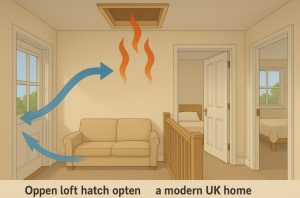
Opening the loft hatch can improve conditions in upper rooms, particularly bedrooms that tend to overheat due to their proximity to the roof. Effectiveness depends on a few variables:
- The presence of open windows or doors on the lower levels
- The external temperature compared to the internal environment
- Whether the loft has effective ventilation or vents to aid air escape
In two-storey houses, opening the loft hatch helps to release built-up hot air and promotes air movement from cooler lower floors upward. The result can be a more balanced indoor temperature.
When Loft Hatch Cooling Is Most Effective?
| Situation | Effectiveness Level | Reason |
| Loft has roof vents and is insulated | High | Air escapes quickly, heat stays out |
| Evening with windows open on ground floor | Moderate to High | Cool air drawn in, warm air expelled |
| Hot midday with sealed loft | Low | Heat remains trapped, limited effect |
| Humid day with no cross-ventilation | Low | Moisture build-up, poor airflow |
How Does Roof Insulation Impact Heat Flow and Loft Ventilation?
Roof insulation plays a critical role in controlling the flow of heat between a home’s interior and the external environment. In the UK, insulation is primarily installed to keep homes warm during colder months. However, its function during warmer weather is just as important, though often overlooked.
During summer, the loft space can reach extremely high temperatures as the roof absorbs solar heat throughout the day. This heat transfers to the air inside the loft, which, if not properly ventilated, becomes trapped. When the loft hatch is closed, the heated air has nowhere to go, and it starts to radiate downwards, warming the upper rooms.
The presence and type of insulation in the loft significantly impact this heat transfer:
- Good insulation with effective ventilation: This setup prevents heat from penetrating into the living spaces while allowing warm air to escape through roof vents, especially when the loft hatch is open.
- Poor or compacted insulation: This can trap heat inside the loft, increasing the chance of it radiating into bedrooms and other rooms directly below.
- Insulation without ventilation: While it may protect rooms from direct heat transfer, it also causes the loft space to act like a sealed oven, storing more heat and eventually impacting comfort indoors.
Breathable insulation materials and proper spacing between insulation and the roofline can improve airflow. This allows air to circulate within the loft and escape through vents when the hatch is open.
Homes with over-insulated or improperly ventilated lofts may experience minimal benefits from opening the hatch. In such cases, the loft becomes a heat reservoir, and opening the hatch might introduce more warm air rather than release it.
A balanced approach, combining insulation with ventilation pathways like soffit, ridge or tile vents, is ideal for maximising cooling effects.
The thermal resistance (R-value) of insulation also matters. High R-value materials prevent heat transfer into living spaces but don’t address trapped heat. This makes strategic loft design with both insulation and ventilation crucial in maintaining a comfortable indoor temperature during hot spells.
Can Opening the Loft Hatch Help with Air Circulation in Summer?
Using the loft hatch strategically can improve airflow throughout the property. By opening it alongside windows on the lower levels, a vertical airflow system is created, commonly known as stack or passive ventilation.
This method encourages warm air to rise and exit through the loft hatch, drawing in cooler outside air from lower points. It is particularly useful on still, warm evenings or mornings when the external air temperature is lower than indoors.
To improve results:
- Open windows on the cooler, shaded side of the house
- Avoid opening the hatch during peak afternoon heat when roof temperatures peak
- Close curtains or blinds on sun-facing windows to prevent further heat gain
Are There Any Risks or Downsides to Opening the Loft Hatch for Cooling?

While this method is cost-effective and easy to implement, some limitations should be considered.
- Security risks: Leaving a loft hatch open overnight or when unattended may present safety concerns in certain house designs
- Fire safety: In homes where the hatch is designed as a fire barrier, keeping it open may reduce its effectiveness
- Pest control: An open hatch may increase the chance of insects or small animals accessing the loft space
- Energy efficiency: In properties with HVAC systems, open hatches may interfere with balanced temperature control
Proper assessment of your home’s loft condition, insulation, and ventilation setup is essential before relying on this as a primary cooling method.
What Alternative Methods Can Help Cool a UK Home Naturally?
While opening the loft hatch can provide some relief, especially on hot summer days or warm evenings, it works best as part of a broader cooling strategy.
There are several effective natural methods that UK homeowners can use to reduce indoor temperatures without relying on mechanical air conditioning.
1. Cross-Ventilation Using Windows and Doors
Creating a flow of air across the home by opening windows on opposite sides is one of the most effective ways to encourage passive cooling.
- Helps remove warm, stagnant air from rooms
- Allows cooler outside air to enter and circulate
- Works best during early mornings and late evenings
When used in conjunction with an open loft hatch, this method enhances the natural convection current, pulling cooler air from lower levels upward.
2. Shading and Window Treatments
Sunlight streaming through windows contributes significantly to indoor heat gain. Managing solar exposure can dramatically lower indoor temperatures.
- Use blackout blinds or thermal curtains on south-facing windows
- Install external shading devices like awnings or shutters
- Apply reflective window films to deflect sunlight
These steps reduce the amount of heat entering the home and help maintain a cooler environment throughout the day.
3. Roof and Loft Ventilation Enhancements
In addition to the loft hatch, homeowners can install dedicated ventilation features in the roof structure.
- Ridge vents, soffit vents or tile vents allow hot air to escape continuously
- Solar-powered loft fans can assist in pulling air out of the loft space
- Gable-end vents improve air turnover in traditional pitched roofs
These upgrades make passive ventilation systems more effective, even when the loft hatch is closed during cooler times or for safety reasons.
4. Natural Insulation Materials and Breathable Design
Using breathable materials such as sheep wool insulation or multi-foil insulation allows air to move within the structure, preventing heat traps. Breathable membranes in the roofing layer also help regulate temperature and humidity inside the loft.
This method improves the home’s ability to maintain consistent indoor temperatures by preventing excessive heat buildup within structural cavities.
5. Evaporative Cooling Techniques
Placing shallow bowls of water or damp towels near windows can cool the air slightly through evaporation, especially in drier indoor environments. Adding indoor plants can also support a cooler atmosphere, as they naturally increase humidity and release moisture.
6. Thermal Mass and Night Purging
Homes with materials like concrete, brick or stone can retain heat during the day. Cooling these materials overnight by increasing airflow helps prevent temperature spikes the next day.
- Keep windows and loft hatch open at night to cool walls and floors
- Close windows and blinds in the morning to trap the coolness
This is especially effective in homes with thick walls or those built before 1950, which have more thermal mass.
Natural Cooling Strategies for UK Homes
| Method | Key Benefit | Best Time to Use |
| Cross-Ventilation | Quick removal of warm air | Morning or Evening |
| Thermal Curtains/Blinds | Reduces solar heat gain | Daytime |
| Roof or Loft Ventilation Vents | Allows trapped hot air to escape | All day |
| Night Purging with Loft Hatch | Cools thermal mass and air volume | Overnight |
| Evaporative Cooling with Water | Slight air temperature reduction | Afternoon |
| Reflective Window Films | Deflects solar radiation | All day (especially sunny days) |
Combining two or three of these approaches can lead to significant improvements in comfort.
Homeowners are encouraged to monitor internal temperatures and humidity levels to determine which methods work best for their specific building design and local weather conditions.
When Is the Best Time to Open the Loft Hatch for Maximum Benefit?
Timing plays a key role in the effectiveness of this approach. Ideally, the loft hatch should be opened:
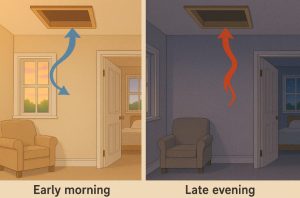
- In the early morning, when the outside air is coolest
- During the evening, after sunset, to release accumulated heat
- Only when external temperatures are lower than indoor temperatures to encourage natural airflow
Avoid keeping the hatch open during the hottest parts of the day unless there’s a consistent breeze or cross-ventilation setup to move air through the house. Monitor the conditions in the loft using a basic thermometer to assess whether opening the hatch is contributing positively to indoor temperature regulation.
How Does Opening the Loft Hatch Compare to Other Ventilation Techniques?
Opening the loft hatch is one of the simplest passive cooling strategies available to homeowners. While it may not match the efficiency of powered systems, it is a low-cost method with reasonable effectiveness, especially in mild climates like the UK.
In comparison to ceiling fans, attic fans, or mechanical ventilation systems, the loft hatch serves more as a supplementary solution than a standalone fix.
It works best when incorporated into a larger strategy that includes managing solar gain, promoting airflow, and improving insulation.
Conclusion
In the context of the UK climate, opening the loft hatch is a practical, cost-free strategy to help cool your home naturally. While it won’t replace air conditioning on extremely hot days, it can play a valuable role in reducing upstairs heat, especially when paired with smart ventilation practices.
For homeowners looking to minimise energy usage and improve indoor comfort during summer, the loft hatch presents a simple and often effective solution — particularly in well-insulated homes with accessible airflow pathways.
FAQs about Cooling Homes by Opening the Loft Hatch
Can opening the loft hatch lower the temperature in all parts of the house?
It primarily affects upper floors by allowing rising hot air to escape. Lower floors benefit when used in conjunction with open windows.
Does a loft ladder affect cooling if the hatch remains open?
Yes, as the ladder itself may obstruct some airflow, but the cooling effect can still be achieved if there’s sufficient vertical clearance.
Should I leave the loft hatch open overnight in summer?
It can be beneficial overnight when outside temperatures drop. However, ensure it’s safe and secure before leaving it open.
Will opening the loft hatch increase humidity in my house?
Possibly, especially on humid days. Use a hygrometer to monitor indoor humidity levels and avoid opening it if moisture levels are high.
Can I improve this method by installing roof vents?
Yes, roof or ridge vents enhance airflow, helping the hot air escape faster and improving the effectiveness of the loft hatch.
Is it safe to open the loft hatch in homes with children?
Safety gates or barriers are recommended if young children are present to prevent access to the open hatch area.
Does leaving the hatch open affect home insulation in the long run?
Occasional use won’t damage insulation, but frequent exposure to temperature shifts might reduce its longevity over time.