If you have checked your property documents and noticed the words “Title Absolute”, you may be wondering what they mean and whether they guarantee that you legally own your home.
Title absolute is the strongest class of registered property title granted by HM Land Registry in England and Wales. It means the Land Registry is satisfied that the registered proprietor has a sufficiently established legal title to the property.
For most homeowners and property buyers, this is reassuring because absolute title offers the highest level of registered ownership protection.
However, title absolute does not mean that a property is free from mortgages, restrictions, legal obligations or every possible ownership dispute.
Understanding the difference is particularly important when buying a house, selling property, applying for a mortgage or dealing with a boundary disagreement.
What Does Title Absolute Mean on Land Registry?
Title absolute, also called absolute title, is the highest class of title that HM Land Registry can grant to registered land and property.
When someone applies to register ownership, HM Land Registry examines the available legal evidence to determine whether their right to the property can be sufficiently established.
If the evidence meets the relevant legal standard, the property may be registered with absolute title.
In practical terms, this means:
- HM Land Registry recognises the registered proprietor’s legal ownership.
- The registered title benefits from the strongest class of title guarantee.
- The ownership evidence meets the standard required for absolute registration.
- The title is generally straightforward for conveyancers and mortgage lenders to assess.
- Ownership remains subject to any applicable registered interests and other legally binding rights.
Frank Ramsay, writing for HM Land Registry in his article The ABC of Title Registers, explained that the class of title reflects the Land Registry’s level of guarantee, based on the strength of the evidence supplied.
This is an important distinction. Absolute title describes the quality of the registered ownership, not a guarantee that the property is entirely free of legal complications.
According to HM Land Registry’s guidance on reading a title register, absolute freehold and absolute leasehold are the best and most common classes of registered title.
Where Can You Find Title Absolute on a Land Registry Document?
You can normally find the class of title in the B: Proprietorship Register section of the property’s title register.
An HM Land Registry title register is usually divided into three sections.
| Register section | Information provided | Why it matters |
| A: Property Register | Property description, tenure and rights benefiting the land | Identifies the property and its legal characteristics |
| B: Proprietorship Register | Registered owners, class of title and restrictions | Confirms who is registered and the quality of title |
| C: Charges Register | Mortgages, restrictive covenants and other burdens | Identifies important financial and legal obligations |
For example, the B register might show the following information:
B: Proprietorship Register
Class of Title: Title Absolute
Proprietor: Example Property Owner
Date of Registration: 15 March 2021
Illustrative example only; not an actual Land Registry record.
The important wording is “Class of Title: Title Absolute”.
This confirms that the title has been registered in the strongest available class.
However, you should read the whole document rather than relying on this single entry.
For instance, the same property might still have a registered mortgage or a restriction requiring another party’s consent before a transaction can be registered.
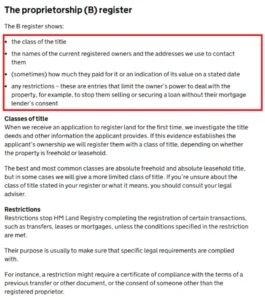
The proprietorship register identifies the class of registered property title and the legal owners.
Homeowners who are unfamiliar with their property records can first learn how to carry out a Land Registry title number search and locate the correct title.
What Is the Difference Between Title Absolute and Freehold Ownership?
A common misunderstanding is that title absolute and freehold mean the same thing.
They describe different aspects of property ownership.
Freehold or leasehold describes the type of legal estate, while absolute title describes the class or quality of its registration.
| Feature | Absolute freehold title | Absolute leasehold title |
| Legal estate | Freehold | Leasehold |
| Class of title | Absolute | Absolute |
| Ownership duration | Potentially indefinite | Limited to the lease term |
| Lease conditions | Not applicable to the freehold itself | Lease obligations apply |
| Land Registry guarantee | Strongest freehold class | Strongest leasehold class |
| Mortgage eligibility | Generally acceptable, subject to lending criteria | Depends additionally on lease terms and lender policy |
Absolute Freehold Title
Absolute freehold title means that HM Land Registry recognises the registered proprietor’s freehold estate with the highest class of title.
The owner generally owns the freehold without an expiry date, although ownership remains subject to relevant legal rights, restrictions and obligations.
Absolute Leasehold Title
Absolute leasehold title means that HM Land Registry has granted the highest class of registration to a leasehold estate.
However, the leaseholder does not automatically own the underlying freehold.
They hold the property for the remaining lease term and must comply with the lease’s conditions.
For example, someone purchasing a flat with 95 years remaining on its lease could have absolute leasehold title.
Their legal title may be properly established, but the lease still expires according to its terms unless it is extended or otherwise changed.
This distinction is particularly important for flat buyers because mortgage lenders also examine the remaining lease length, ground rent, service charges and other lease obligations.
Does Title Absolute Mean Property Ownership Cannot Be Challenged?
No. Although absolute title offers the strongest form of registered ownership protection, it does not make ownership impossible to challenge in every circumstance.
There are several important limitations.
1. Overriding interests may still apply
Certain legal rights can bind a registered owner even though they are not recorded in the title register.
These are known as overriding interests.
Depending on the circumstances, examples may include particular rights of people in actual occupation or certain legal easements.
2. The register can sometimes be corrected
Where the register contains a qualifying mistake, HM Land Registry or a court may have legal powers to alter it.
These powers are subject to statutory safeguards, and compensation may be available in appropriate cases.
3. Registered restrictions remain enforceable
Absolute title does not remove restrictions affecting the registered proprietor’s ability to sell, transfer or mortgage the property.
4. Boundary disagreements can still arise
Absolute title does not necessarily establish the exact position of every legal boundary.
Most title plans show general boundaries rather than precise measurements.
For instance, two neighbours might both own their properties with absolute title but disagree about the position of a garden fence.
The classification of their titles does not automatically resolve that disagreement.
The distinction between the legal title and physical boundary position becomes clearer when reviewing a Land Registry compliant plan alongside the relevant historical documents.
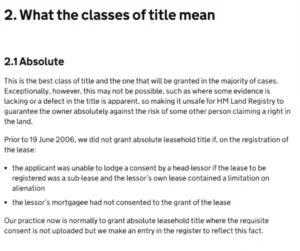 HM Land Registry identifies absolute title as the strongest class of registration, while recognising circumstances where a lower class may be necessary.
Does Having Title Absolute Mean There Is No Mortgage on the Property?
No. A property can have absolute title while being subject to an outstanding mortgage.
The class of title and the mortgage are separate legal matters.
For example, consider a homeowner who buys a £300,000 property using a £240,000 mortgage.
The property could be registered with absolute freehold title, while the mortgage lender has a legal charge registered against it.
The absolute title establishes the class of the homeowner’s legal estate. It does not mean the homeowner has repaid the mortgage.
Similarly, an absolute title does not automatically remove:
- Restrictive covenants
- Rights of way
- Registered charges
- Leasehold obligations
- Restrictions on dispositions
- Certain third-party interests
Buyers should check the charges register and investigate any relevant restrictions before completing the purchase.
This is why conveyancing professionals investigate more than ownership alone.
What Are the Different Classes of Land Registry Title?
HM Land Registry recognises several classes of registered title.
The main categories are absolute, possessory, qualified and good leasehold title.
| Class of title | Meaning | Practical concern |
| Absolute | Strongest class of registered title | Other legal interests may still affect the property |
| Possessory | Ownership evidence is incomplete or title is based on possession | Earlier rights or stronger claims may need investigation |
| Qualified | A specific title defect or limitation has been identified | The recorded exception must be examined |
| Good leasehold | The leaseholder’s title is established, but the landlord’s right to grant the lease has not been fully verified | Superior title and lease validity require additional checks |
Absolute title is generally the preferred position for buyers because the ownership evidence has met the higher registration standard.
However, a property with another class of title is not necessarily unsaleable.
The practical risk depends on the reason for the lower classification, available supporting evidence, the lender’s requirements and any suitable insurance arrangements.
For example, possessory title may arise where original ownership documents have been lost or an application involves adverse possession.
Andrew Boast, a conveyancing specialist and author at SAM Conveyancing, advises buyers considering possessory-title property to obtain their mortgage lender’s consent and consider possessory title indemnity insurance.
That advice highlights an important commercial issue: a lower class of title can affect a transaction even where the person selling the property appears to have occupied it for many years.
There is more detail about the legal implications, lender concerns and potential insurance arrangements in our explanation of possessory title.
Can You Upgrade a Property Title to Absolute?
Yes. In appropriate circumstances, an owner can apply to HM Land Registry to upgrade a lower class of registered title.
However, the process depends on the existing title classification and the evidence available.
HM Land Registry explains the requirements in its official Practice Guide 42: Upgrading the Class of Title.
Upgrading Possessory Title
Possessory title can potentially be upgraded where sufficient additional ownership evidence becomes available.
There is also a time-based route.
Where a possessory title has been registered for at least 12 years, an eligible applicant may seek an upgrade under the relevant statutory conditions.
For a freehold estate, this may result in absolute freehold title.
For a leasehold estate, the time-based route normally leads to good leasehold title rather than automatically granting absolute leasehold title.
The 12-year period does not mean the title automatically changes. An application is still required, and the relevant conditions must be satisfied.
Nor should the 12-year registered possessory-title rule be confused with the separate legal requirements governing adverse possession.
Upgrading Qualified Title
Qualified title may be upgraded where the applicant supplies satisfactory evidence addressing the defect or reservation that originally prevented absolute registration.
Unlike possessory title, qualified title does not become eligible for upgrading merely because a fixed period has passed.
Upgrading Good Leasehold Title
A good leasehold title can sometimes be upgraded to absolute leasehold title.
This usually involves demonstrating the landlord’s title and any relevant superior titles, together with other evidence required by HM Land Registry.
How to Apply for an Upgrade?
The process generally involves:
- Checking the existing class of title.
- Identifying why HM Land Registry granted a lower class.
- Gathering documentary evidence or establishing eligibility under the relevant time-based rule.
- Completing the appropriate upgrade application using Form UT1.
- Submitting the application and any applicable fee.
- Responding to requests for further evidence or clarification.
Some applications can be made as part of another registration transaction.
A conveyancing solicitor can assess the appropriate route and whether additional evidence is likely to be sufficient.
How Can You Check Whether Your Property Has Title Absolute?
Anyone can search for registered property information in England and Wales through HM Land Registry’s official service.
You do not have to own the property to request publicly available title information.
The process is straightforward.
Step 1: Find the official property information service
Visit GOV.UK and search for “Search for land and property information”.
Use the government service rather than an unofficial website charging extra for the same records.
Step 2: Search for the property
Enter the relevant address or postcode and select the correct property.
Take care with converted buildings, blocks of flats, separate garages and properties containing multiple registered titles.
Step 3: Check the free property summary
The property summary is free and can provide basic information, such as the tenure type and property description.
However, the full class of title should be confirmed using the title register.
Step 4: Obtain the title register
The standard online title register currently costs £7 through the official service.
A separate title plan also costs £7.
Official copies ordered for formal proof of ownership cost £11 per document.
Step 5: Read the proprietorship register
Look for the wording identifying the class of title.
The register will indicate whether the property has absolute, possessory, qualified or good leasehold title.
You should also check the registered proprietor and any restrictions.
Step 6: Review the other sections
Look for relevant mortgages, easements, covenants, lease details and other matters affecting the property.
A title register should not be treated as a substitute for full conveyancing enquiries.
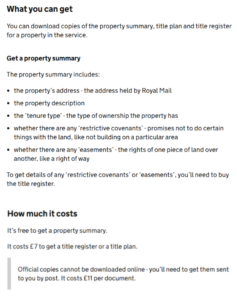
The GOV.UK property information service lets users obtain a property summary and purchase the title register.
Does Absolute Title Make a Property Easier to Sell or Mortgage?
Absolute title is generally beneficial when selling, buying or remortgaging property because it reduces uncertainty about the quality of the registered legal title.
However, it does not guarantee that a transaction will proceed without complications.
When Buying Property?
A buyer’s solicitor will normally investigate the seller’s registered title and identify any legal issues requiring clarification.
The assessment may include:
| Due diligence check | Why it matters |
| Class of title | Establishes the quality of registered ownership |
| Registered proprietor | Confirms who is entitled to deal with the registered estate |
| Restrictions | Identifies conditions affecting registration of a transfer |
| Charges | Reveals registered mortgages and other financial interests |
| Covenants | Identifies limitations on property use |
| Easements | Establishes rights of access and other rights over land |
| Lease terms | Identifies leasehold obligations and expiry dates |
| Title plan | Helps establish the general extent of the registered property |
The legal investigation may also include documents referred to in the register that are not reproduced in full.
When Selling Property?
For sellers, a clear registered title can help conveyancers respond to buyers’ questions.
However, even a property with absolute title may require additional documents, such as evidence of a mortgage discharge, a deed referred to in the register or consent from a management company.
Problems discovered during conveyancing enquiries should be resolved before the parties commit to exchange where necessary.
Our article about what happens after conveyancing enquiries are answered explains how unresolved legal matters can influence the progress of a property transaction.
When Applying for a Mortgage?
Mortgage lenders generally prefer property with a clearly established, marketable legal title.
Absolute title is ordinarily reassuring, but lenders also consider valuation, lease terms, property condition, restrictions, borrower affordability and their own lending policies.
A property with absolute title could still be unsuitable for a particular mortgage product.
For example, a flat may have absolute leasehold title but an insufficient remaining lease term for a lender’s requirements.
The quality of ownership registration and the mortgageability of the property must therefore be considered separately.
What Should You Do If the Land Registry Details Are Incorrect?
Discovering an unexpected entry in your title register does not automatically mean someone else owns your property.
The problem might involve an outdated address, a registration application awaiting completion, an omitted document or another issue requiring investigation.
The appropriate response depends on the nature of the discrepancy.
Start by obtaining the current register and identifying the precise entry that appears incorrect.
Then contact your conveyancer or seek advice from a property solicitor before applying to correct the register.
If there is a genuine error, the relevant statutory procedures may allow HM Land Registry to alter the entry.
However, a correction to a register and an application to upgrade the class of title are not the same process.
Where the matter concerns missing deeds or an application supported by a formal declaration, our explanation of statements of truth used in Land Registry applications provides additional context.
Professional advice is particularly important if another person claims an interest in the property or a correction might affect existing ownership rights.
What Should Buyers Check Before Purchasing a Property With Title Absolute?
Suppose you are buying a three-bedroom freehold house for £325,000.
Your solicitor obtains the title register and confirms that it has absolute freehold title.
This is a favourable starting point because HM Land Registry has granted the strongest class of registration.
However, imagine the charges register also reveals a restrictive covenant affecting extensions.
The title plan shows the general boundary of the land, but the garden fence appears to extend beyond the area shown on older conveyancing documents.
In this example, the property has absolute title, yet there are still two separate matters requiring investigation.
A buyer should establish whether the proposed extension would breach the covenant and whether the disputed garden strip forms part of the property being purchased.
The main lesson is that absolute title confirms the quality of registered ownership, not the absence of every legal or physical property issue.
A qualified conveyancing solicitor can investigate these questions, assess any effect on mortgage lending and explain the risks before exchange.
FAQs
Is title absolute good or bad?
Title absolute is generally good. It is the strongest class of registered title available through HM Land Registry in England and Wales and provides the highest level of title assurance.
Does title absolute mean you own the land?
It means the registered proprietor holds the legal estate with the strongest class of title. The precise ownership rights depend on whether the estate is freehold or leasehold and any applicable legal interests.
Is title absolute the same as freehold?
No. Freehold describes the type of legal estate, while absolute describes its class of registration. Both freehold and leasehold properties can have absolute title.
Can someone claim land that has title absolute?
Claims or disputes can still arise in limited circumstances, including issues involving overriding interests, mistakes or other legally recognised rights. Absolute title provides strong protection but not immunity from every claim.
Can you sell a property without title absolute?
Yes. Properties with possessory, qualified or good leasehold title may still be sold. However, buyers and mortgage lenders may require additional evidence, advice or suitable indemnity insurance.
Does absolute title mean there are no restrictive covenants?
No. A property can have absolute title while remaining subject to restrictive covenants, rights of way, mortgages or other registered and overriding interests.
How long does it take to upgrade possessory title to absolute?
There is no single guaranteed processing period. Eligibility depends on the circumstances, the relevant evidence and HM Land Registry’s requirements. A possessory title registered for 12 years may qualify for the time-based upgrade route, but the change is not automatic.