HMRC recovered £104.3 million from landlord tax disclosures and related compliance work in 2025–26, after 11,511 landlords came forward—the highest disclosure count since 2018–19.
The average payment fell to £9,063 from £13,713 a year earlier, indicating that the HMRC landlord tax crackdown is reaching more people with smaller individual liabilities.
The figures also show a third consecutive year above £100 million and a recovery total almost three times the £36.8 million collected in 2019–20.
Key Takeaways
- The wider net appears to include accidental and single-property landlords.
- Data matching and nudge letters are prompting many disclosures.
- Historic errors can involve tax, interest and behaviour-based penalties.
- Digital reporting is expanding across three income thresholds by April 2028.
Receiving a letter does not prove deliberate wrongdoing, but it should not be ignored. Landlords need to check rental income, allowable expenses, mortgage-interest treatment, property disposals and the disclosure route that fits their circumstances without unnecessary delay.
What Does the Latest HMRC Landlord Tax Crackdown Reveal?

The figures show that landlord compliance remains a significant source of recovered tax.
The £104.3 million total covers receipts associated with the Let Property Campaign and wider compliance work, including action involving people who did not respond and discovery assessments raised by HMRC.
Annual Tax Recovered
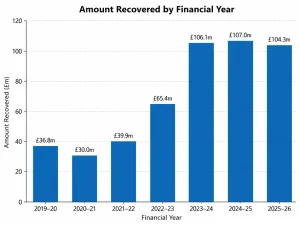
| Financial Year | Amount Recovered |
| 2019–20 | £36.8m |
| 2020–21 | £30.0m |
| 2021–22 | £39.9m |
| 2022–23 | £65.4m |
| 2023–24 | £106.1m |
| 2024–25 | £107.0m |
| 2025–26 | £104.3m |
Receipts have therefore exceeded £100 million for three consecutive years. The Let Property Campaign has reportedly generated £674 million since its launch in 2013–14, although the yield from individual disclosures can vary considerably.
In a statement supplied to the press, an HMRC spokesperson said:
“Our nudge letters help customers pay the correct amount of tax. By paying correctly and on time, they avoid penalties and interest.”
The £104.3 million should not be described solely as fines because the total principally reflects unpaid tax recovered alongside applicable interest and penalties.
Why Are More Landlords Disclosing Smaller Amounts?
Disclosure volumes increased from 7,803 in 2024–25 to 11,511 in 2025–26, a rise of about 47.5%. At the same time, the average payment dropped from a record £13,713 to £9,063, a reduction of approximately 33.9%.
This combination supports an important interpretation: HMRC appears to be reaching a broader pool of landlords with smaller liabilities.
Andrew Park, the tax investigations partner quoted in the reference reporting, described a clear trend towards larger numbers of smaller cases and linked many disclosures to HMRC nudge letters.
That does not prove HMRC has adopted a wholly new enforcement policy. It does, however, suggest data-led checks are identifying errors among single-property owners, accidental landlords and people with modest rental income—not only large professional portfolios.
How Is HMRC Finding Undeclared Rental Income?

HMRC can compare information held in tax records with property ownership and other third-party data. A discrepancy does not automatically establish unpaid tax, but it can prompt a request for the owner to explain how a property has been used.
Property Ownership and Tax-Record Matching
The analysis accompanying the disclosure figures says HMRC is increasingly using Land Registry records to identify people who own several residential properties but do not appear to have declared corresponding rental income.
Property ownership alone is not proof of letting: a home may be vacant, occupied by relatives or used privately.
However, where declared property income appears inconsistent with ownership information, HMRC can ask for tenancy records, letting-agent statements, bank transactions or previous Self Assessment returns.
What Is an HMRC Nudge Letter?
A nudge letter asks a taxpayer to review their affairs and correct any error. It is not necessarily a formal investigation or an allegation of deliberate evasion.
A recipient may be asked to confirm that no tax is due, amend a recent return or make a disclosure covering earlier years. Ignoring the letter may lead to follow-up action, particularly when HMRC already holds information suggesting rental activity.
Accidental Landlords Under Greater Scrutiny
Accidental landlords may include people who retained a home after moving in with a partner, inherited a tenanted property or rented out a UK home while temporarily living overseas.
Their obligations are determined by taxable property income, not by whether they regard themselves as professional landlords. A lack of awareness may help explain an error, but it does not automatically remove the unpaid tax.
Which Landlord Tax Mistakes Are Most Likely to Attract HMRC Attention?
HMRC checks can arise from omitted income or from an incorrect calculation of taxable rental profit.
Common Reporting and Calculation Errors
- Failing to include rental income on a Self Assessment return.
- Assuming the £1,000 property allowance removes every filing obligation.
- Using the net amount received from an agent without reviewing gross rent and expenses.
- Claiming substantial property improvements as routine repairs.
- Deducting residential mortgage interest directly from rental income.
- Reporting the wrong share of income from jointly owned property.
- Omitting UK rent received while living overseas.
- Missing Capital Gains Tax after selling a rental property.
A like-for-like replacement of an existing kitchen may generally be treated differently from installing a substantially higher-specification kitchen. The facts and purpose of the expenditure determine whether it is a revenue repair or a capital improvement.
Mortgage interest is another source of error. Since 6 April 2020, individual residential landlords have generally received a basic-rate tax reduction rather than a full deduction from rental income, as explained in the official landlord finance-cost guidance.
This can create the “phantom profit” effect: taxable property profit may arise even when mortgage payments leave little real-world cash profit.
How Does the Let Property Campaign Help Landlords Correct Unpaid Tax?

The campaign gives eligible individual landlords a structured route to disclose unpaid tax on residential letting income. It does not cancel the liability, but complete cooperation can affect how HMRC assesses the disclosure and penalties.
Who Can Use the Campaign?
The official Let Property Campaign guidance covers individual landlords with undisclosed income from UK or overseas residential property.
This may include single-property landlords, portfolio owners, holiday landlords, overseas residents with UK property and people renting inherited homes.
It does not generally cover disclosures made on behalf of a company or trust, or cases involving only non-residential property. Joint owners normally need separate disclosures for their respective shares.
The Disclosure Process
A landlord first notifies HMRC of the intention to disclose. HMRC then issues a disclosure reference and payment reference, after which the landlord calculates the omitted income, allowable expenses, tax, interest and proposed penalty.
The completed disclosure and payment must be submitted by the stated deadline. Where full payment is not possible, arrangements should be agreed with HMRC before that deadline.
Incomplete records may be reconstructed using bank statements, tenancy agreements, agent records and reasonable estimates that can be explained.
When Does the 90-Day Deadline Begin?
The 90-day period generally starts from the date HMRC issues the notification acknowledgement, not the date on which the landlord first notices the error. HMRC recommends gathering records early because calculating several years of rental income can be complex.
A landlord already facing a formal compliance investigation may not receive the same campaign treatment as someone who makes a full disclosure before HMRC intervenes.
What Penalties and Look-Back Periods Can Landlords Face?
The amount due may consist of unpaid tax, late-payment interest and a penalty based on the taxpayer’s behaviour. HMRC considers whether the error arose despite reasonable care, through carelessness, through deliberate action or because the taxpayer failed to notify a liability.
Potential Assessment Periods
- Up to four years may apply where reasonable care was taken.
- Up to six years may apply where an error was careless.
- Up to 20 years may apply to deliberate understatement.
- Up to 20 years may apply where HMRC was not notified of the liability.
HMRC states that most Let Property Campaign disclosures are expected to cover no more than six years, but longer periods can apply where income was deliberately understated or never reported.
An unprompted disclosure can receive different penalty treatment from one made after an HMRC letter. No particular reduction is guaranteed because the outcome depends on timing, behaviour, cooperation and the completeness of the disclosure.
How Will Making Tax Digital Increase Landlord Tax Visibility?

Making Tax Digital for Income Tax now requires affected landlords to maintain digital records and submit quarterly updates using compatible software. Qualifying income is broadly gross property and self-employment income before expenses.
Implementation Thresholds
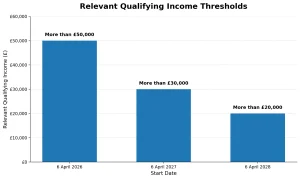
| Start Date | Relevant Qualifying Income |
| 6 April 2026 | More than £50,000 |
| 6 April 2027 | More than £30,000 |
| 6 April 2028 | More than £20,000 |
The Making Tax Digital eligibility guidance confirms all three stages. For many landlords in the first mandatory group, the initial quarterly period ran from 6 April to 5 July 2026, with an update deadline of 7 August 2026.
Digital reporting is not itself an automatic tax investigation. However, more structured and frequent information may make inconsistencies easier to identify.
Separately announced property-income tax rates of 22%, 42% and 47% are planned from 2027–28, with residential finance-cost relief moving to the 22% property basic rate.
What Should Landlords Do After Receiving an HMRC Letter?
The recipient should first establish what HMRC is asking, which properties and tax years are involved and when a response is required. The letter should neither be dismissed nor treated as proof that HMRC’s assumptions are correct.
Immediate Steps After HMRC Contact
- Confirm that the communication is genuine.
- Read the requested action and response deadline.
- Compare rent received with bank and letting-agent statements.
- Review the relevant Self Assessment property pages.
- Separate allowable repairs from capital improvements.
- Check residential mortgage-interest treatment.
- Review jointly owned and overseas property income.
- Identify any unreported rental-property disposals.
- Retain copies of calculations and correspondence.
A landlord who finds no error should still provide the requested response and evidence. A landlord who identifies an omission should determine whether an amended return, campaign disclosure or another disclosure facility is appropriate.
When Should Professional Advice Be Sought?
Specialist advice may be appropriate where several years or properties are involved, records are incomplete, the behaviour may have been deliberate or Capital Gains Tax is also outstanding.
Advice may also be useful where a company or trust owns the property, the landlord lives outside the UK or immediate payment is not possible. An adviser can assist with the calculation and communication, but responsibility for an accurate and complete disclosure remains with the taxpayer.
What Does the Crackdown Mean for UK Landlords in 2026 and Beyond?

The figures indicate that modest rental income is no longer a reliable reason to assume HMRC will not ask questions. The lower average payment, combined with far more disclosures, points towards wider compliance coverage.
Landlords are also operating within a more complex tax environment. The Capital Gains Tax annual exempt amount is £3,000, while individual residential-property gains may be taxed at 18% or 24%, depending on the taxpayer’s income position.
Limited companies generally face Corporation Tax rates ranging from 19% for qualifying small profits to a 25% main rate, with marginal relief between the relevant thresholds.
These figures do not mean every landlord will be investigated. They do show why property owners should maintain complete records, report disposals correctly and correct known errors before a nudge letter develops into more formal action.
Conclusion
The latest HMRC landlord tax crackdown recovered £104.3 million while producing the highest number of landlord disclosures since 2018–19.
The sharp rise in cases, together with the lower average payment, suggests that compliance activity is reaching more accidental, single-property and modest-income landlords.
Property owners should check that all rental income, allowable expenses, finance costs and disposals have been reported under the rules applying to each tax year.
Where an omission is found, early and complete disclosure is generally more constructive than waiting for HMRC to pursue the discrepancy.
Frequently Asked Questions
Is the £104.3 Million Recovery Made Up Entirely of Penalties?
No, the figure principally represents tax recovered through disclosures and related compliance work. Interest and penalties may form part of individual settlements.
Does the £1,000 Property Allowance Exempt Every Landlord?
No, the allowance applies to qualifying property income and does not remove every reporting requirement. A landlord’s wider income and circumstances determine whether HMRC must be told.
Can HMRC Check Income From Jointly Owned Property?
Yes, each owner may have to report the appropriate share of rental income. Married couples and civil partners may face additional rules concerning beneficial ownership and valid declarations.
Can a Limited Company Use the Let Property Campaign?
No, the campaign is intended for eligible individual residential landlords. Companies and trusts generally need to use another disclosure route.
What Records Can Replace Missing Bank Statements?
Tenancy agreements, agent statements, invoices, mortgage records and later bank statements may help reconstruct the figures. HMRC may ask how any estimate was calculated.
Can a Landlord Arrange More Time to Pay?
A landlord who cannot pay by the deadline should contact HMRC before submitting the disclosure. Any payment arrangement must normally be agreed by the specified date.
Are Overseas Landlords Included in UK Property Tax Checks?
A person living overseas can still owe UK tax on income from UK property. The Non-resident Landlord Scheme and Self Assessment requirements may also apply.
Note
Tax treatment depends on the taxpayer’s circumstances and the rules applying to each tax year. Current HMRC guidance or advice from a suitably qualified tax professional should be reviewed before submitting a disclosure.