Last Updated On – 10-09-2026
If a blocked drain outside serves only your property and is within your property boundary, you or your landlord are usually responsible for clearing and repairing it. If the blockage is in a public sewer or, in England and Wales, a lateral drain beyond your property boundary, the local sewerage company is usually responsible.
For a shared drain serving several properties, responsibility will usually fall to the sewerage company if it forms part of the public or transferred sewer network.
However, genuinely private or unadopted drainage systems can remain the responsibility of the connected property owners.
A blocked drain in the street can be different again. Road gullies and highway surface-water drains are normally the responsibility of the relevant highway authority, rather than the sewerage company.
Who Should Deal With The Blockage?
| Where Is The Blockage? | Who Is Usually Responsible? | What Should You Do? |
| Private drain inside your property boundary | Homeowner or landlord | Arrange a drainage contractor |
| Lateral drain beyond your boundary in England or Wales | Sewerage company | Report it to your sewerage provider |
| Public sewer | Sewerage company | Contact the sewerage provider |
| Shared public or transferred sewer | Sewerage company | Report the blockage before paying privately |
| Private or unadopted sewer | Property owner or connected owners | Check ownership and arrange repairs |
| Road gully or highway drain | Highway authority | Report it to the relevant road authority |
| Drain in a rented property | Usually landlord unless tenant misuse caused it | Notify the landlord first |
| Communal private drain in flats | Freeholder, management company or owners depending on the arrangement | Check the lease and drainage ownership |
The key point is that an outside drain is not automatically the water company’s responsibility.
What matters is whether the pipe is private or public, where it sits in relation to the property boundary and whether it serves one property or several.
Last Updated: 10.09.2026
What Is The Difference Between A Drain, Lateral Drain And Sewer?
The terms drain, lateral drain and sewer are often used interchangeably, but they have different meanings.
A private drain normally takes wastewater away from a single property. In England and Wales, the homeowner is generally responsible for the section within their property boundary.
A lateral drain carries wastewater from one property towards a sewer but runs beyond that property’s boundary. Most qualifying lateral drains connected to public sewers in England and Wales are maintained by sewerage companies.
A sewer collects wastewater from more than one property. Public sewers are generally maintained by the relevant sewerage company.
| Drainage Type | What It Usually Serves | Typical Responsibility In England And Wales |
| Private Drain | One property | Property owner |
| Lateral Drain | One property beyond its boundary | Sewerage company in most cases |
| Public Sewer | Multiple properties | Sewerage company |
| Private Sewer | Multiple properties outside the public network | Private owner or owners |
The exact arrangement can vary where drainage is private, newly constructed, off-mains or subject to different rules elsewhere in the UK.
Does An Outside Drain Automatically Belong To The Water Company?
No. This is one of the most common misunderstandings about blocked outside drains.
A drain can be several metres outside the house but still sit within the property’s garden or driveway and serve only that home. That section may remain the homeowner’s responsibility.
For example, a pipe running from a kitchen beneath the back garden towards the property boundary could still be a private drain.
Conversely, a public sewer can run underneath someone’s private garden. The fact that the pipe crosses private land does not necessarily mean the homeowner owns it.
The important questions are:
- Where Is The Property Boundary?
- Does The Pipe Serve One Property Or Several?
- Has The Drain Or Sewer Been Adopted By The Sewerage Company?
- Is It Part Of Highway Drainage Rather Than The Sewerage Network?
Checking these points is more reliable than simply deciding responsibility based on whether a blockage appears indoors or outdoors.
How Drain And Sewer Responsibility Has Changed Over The Years?
Responsibility has changed significantly, particularly in England and Wales.
| Period | What Changed |
| Before October 2011 | Homeowners could be responsible for private sewers and lateral drains outside their own boundaries |
| 1 October 2011 | Most qualifying private sewers and lateral drains connected to the public network in England and Wales transferred to regulated sewerage companies |
| By 1 October 2016 | Eligible private pumping stations serving relevant drainage systems were also transferred |
| 2026 | Property owners generally remain responsible for private drains within their boundary, while sewerage companies maintain most transferred lateral drains and public sewers |
This history matters because older property documents may refer to responsibilities that changed following the 2011 transfer.
Not every drainage asset transferred. Certain private systems, off-mains drainage and other excluded arrangements can remain privately maintained.
Who Is Responsible For Blocked Drains Outside Your Property?
For a typical property in England or Wales, responsibility can often be established by looking at the property boundary.
If the blocked drain serves only your property and the blockage is within your boundary, you will normally need to arrange and pay for the work.
If the obstruction is in a public sewer or a qualifying lateral drain maintained by the sewerage company, the company should investigate and deal with the problem.
Shared drainage needs closer attention. If a pipe takes wastewater from several properties, it may be a public or transferred sewer rather than a private drain.
However, private and unadopted systems still exist. Properties using septic tanks, cesspools, treatment plants or other private drainage arrangements may have different responsibilities.
Blocked Drain On The Road Or Pavement: Council Or Water Company?
A blocked drain beside a road is not automatically a water-company problem.
Road gullies and highway drains primarily collect surface water from roads. On local adopted roads, these are generally maintained by the relevant highway authority.
In England, National Highways manages the strategic road network, including motorways and major A-roads under its control.
A public foul or combined sewer, however, is normally the responsibility of the sewerage company even when it runs beneath a pavement or road.
A simple way to distinguish them is to look at the nature of the problem.
| Problem | Who To Contact First |
| Road gully overflowing after rainfall | Highway authority |
| Sewage coming from a public manhole | Sewerage company |
| Multiple neighbouring houses backing up | Sewerage company |
| Private garden drain blocked | Homeowner or landlord |
| Drainage problem on a motorway or strategic road in England | National Highways |
If sewage is escaping rather than ordinary rainwater, report it promptly to the sewerage company.
How To Work Out Who Is Responsible For The Blockage?
Before paying a contractor, try to establish whether the affected pipe is private or part of the public network.
Check Whether Your Neighbours Are Affected
If several neighbouring homes are experiencing slow drains, overflowing toilets or sewage problems simultaneously, the blockage may be within a shared or public sewer.
Check Different Fixtures
If every toilet, sink and shower in your home is backing up, the problem may be further along the drainage system rather than at one individual appliance.
Identify Your Property Boundary
Land Registry plans, title documents and property information may help establish the approximate boundary.
Check Drainage And Sewer Records
Sewerage companies maintain records of many public sewers. However, private drains are not always fully mapped.
Consider A CCTV Drain Survey
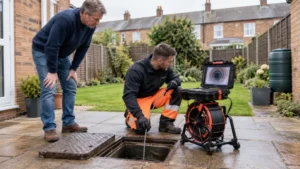
A drainage contractor can use CCTV equipment to find collapsed pipes, root intrusion, damaged joints and stubborn obstructions. It can also help establish where the defect is located.
Where ownership remains uncertain, contact the sewerage company before authorising expensive excavation.
Who Is Responsible For Blocked Drains In Rented Properties?
Landlords are generally responsible for keeping drainage installations associated with a rented property’s structure in repair, although the exact legal position varies across the UK.
A tenant may potentially be charged where there is clear evidence that the blockage resulted from misuse rather than deterioration or a structural problem.
Examples can include:
- Flushing Wet Wipes Or Sanitary Products
- Pouring Large Quantities Of Fat Or Grease Down Sinks
- Putting Unsuitable Objects Into Toilets
- Failing To Report A Developing Problem That Then Causes Further Damage
Tree-root intrusion, collapsed pipes, ageing drains and structural faults are less likely to be considered ordinary tenant responsibility.
Where the blockage is in a public sewer, the landlord or tenant can report the problem to the relevant sewerage company.
Who Is Responsible For Drains In Flats And Leasehold Properties?
Drainage responsibility can be more complicated in flats.
A pipe serving only one flat may fall within that leaseholder’s or landlord’s responsibility, while communal drainage serving several flats may form part of the building’s shared infrastructure.
Responsibility can depend on:
- The Lease Terms
- Where The Blockage Is Located
- How Many Properties The Pipe Serves
- Whether The Pipe Is Public Or Private
- Whether A Freeholder Or Management Company Maintains Communal Services
- Whether The Blockage Was Caused By Misuse
Leaseholders should check their lease and contact the managing agent or freeholder before commissioning significant communal drainage work.
Does Drain Responsibility Differ Across The UK?
Yes. The broad principle of private owners looking after private drainage and public providers maintaining public sewers exists across the UK, but the detailed ownership rules are not identical.
| Nation | General Position |
| England | Most qualifying lateral drains and private sewers transferred to sewerage companies from October 2011 |
| Wales | Similar 2011 transfer arrangements apply to most qualifying private sewers and lateral drains |
| Scotland | Homeowners generally maintain their private drainage connections, while Scottish Water maintains the public sewer network |
| Northern Ireland | Private drains remain the responsibility of the property owner or occupier, while NI Water maintains the public sewer network |
This difference is particularly important when researching lateral drains because rules applying in England and Wales should not automatically be assumed to apply in Scotland or Northern Ireland.
Who Pays For A Blocked Or Collapsed Drain?
If a blockage is within a private drain for which you are responsible, you will normally pay the drain-clearance cost.
If the obstruction lies within a sewerage-company asset, the company should normally deal with its own infrastructure.
Where a genuinely private sewer serves several homes, costs may be shared between the owners according to ownership arrangements and legal agreements.
Buildings insurance may sometimes cover damage to underground drains, particularly where accidental damage, subsidence or structural failure is involved. Routine cleaning, poor maintenance or simple blockages may be excluded.
Check the policy wording before arranging major repairs.
What To Do If Sewage Is Backing Up Or Flooding Your Property?
Sewer flooding should be treated more urgently than an ordinary slow-running drain.
Take sensible precautions:
- Stop Using Toilets, Sinks And Appliances That Discharge Wastewater Where Possible
- Keep Children And Pets Away From Contaminated Water
- Contact The Sewerage Company If A Public Sewer May Be Involved
- Tell Your Landlord Or Managing Agent If You Rent
- Photograph Damage Where It Is Safe To Do So
- Contact Your Insurer If The Building Or Belongings Have Been Damaged
- Keep Receipts, Contractor Reports And Correspondence
- Avoid Opening Or Entering Manholes Where It Is Unsafe
Do not enter drains or confined drainage spaces yourself because they can contain dangerous gases and other hazards.
Can You Get Compensation For Sewer Flooding?
Customers may be entitled to payments where flooding results from sewerage-company assets and the relevant guaranteed service conditions are met.
In England, current Guaranteed Standards Scheme payments for internal sewer flooding are based on the customer’s annual sewerage charge, subject to a minimum of £300 and maximum of £2,000 for an incident.
For qualifying material external sewer flooding in England, the payment is generally 50% of annual sewerage charges, with a minimum of £150 and maximum of £1,000.
Higher minimum and maximum amounts can apply to repeated qualifying incidents within a rolling 12-month period.
Wales currently operates different statutory payment levels. For households, qualifying internal sewer flooding generally has a minimum payment of £150 and maximum of £1,000, while material external flooding has a minimum of £75 and maximum of £500.
Eligibility conditions and exceptions apply, so sewer flooding does not automatically guarantee the maximum payment.
How To Prevent Outside Drains From Becoming Blocked?
Many drainage emergencies can be reduced through basic maintenance and responsible disposal.
Common causes include:
- Tree Roots entering cracked or damaged underground pipes
- Fats, Oils And Grease cooling and solidifying inside drains
- Wet Wipes building up within drainage systems
- Sanitary Products being flushed instead of disposed of properly
- Leaves And Soil entering outdoor gullies
- Damaged Pipes creating places where waste catches
- Collapsed Sections restricting wastewater flow
Clear accessible leaves and debris from outdoor gullies regularly and avoid pouring cooking fat down sinks.
Recurring blockages deserve investigation rather than repeated temporary clearing. CCTV inspection can help identify structural defects that ordinary drain rods or jetting will not permanently solve.
Conclusion
When dealing with blocked drains outside, who is responsible depends mainly on ownership, location and what the pipe serves.
A homeowner or landlord will normally be responsible for a private drain serving one property.
In England and Wales, most qualifying lateral drains outside property boundaries and public sewers are maintained by sewerage companies following the transfer that took effect in October 2011.
Road gullies are usually dealt with by the relevant highway authority, while different rules can apply to private drainage systems, flats, rented properties and parts of Scotland and Northern Ireland.
Before paying for substantial drainage work, establish the property boundary, check whether neighbouring homes are affected and confirm whether the affected pipe forms part of the public sewer network.
FAQs
Who Is Responsible For A Blocked Drain Outside My Property?
If the drain serves only your property and is within your boundary, you are normally responsible. In England and Wales, most lateral drains beyond the boundary and public sewers are usually maintained by the sewerage company.
Is The Council Responsible For Blocked Drains On The Road?
The relevant highway authority generally deals with road gullies and highway surface-water drainage on roads it maintains. Public sewer blockages should normally be reported to the sewerage company.
Who Is Responsible For A Shared Drain Between Neighbours?
If a drainage pipe serves several properties, it may form part of a public or transferred sewer in England and Wales. Truly private shared drainage systems can still exist, so ownership should be checked before arranging repairs.
Is A Landlord Responsible For A Blocked Outside Drain?
Landlords are generally responsible for structural drainage repairs associated with rented properties. A tenant may potentially be responsible where evidence shows that misuse caused the blockage.
How Do I Know If A Drain Belongs To The Water Company?
Check where the drain sits, which properties it serves and the sewerage company’s records. Property documents and a CCTV drain survey can also help establish ownership.
Does Buildings Insurance Cover Blocked Or Collapsed Drains?
Some policies cover accidental or structural damage to underground drains, but routine blockage removal and maintenance may not be included. Coverage depends on the individual policy.
Who Is Responsible For A Manhole In My Garden?
A manhole being inside your garden does not automatically make it private. Public sewers can cross private land, so check with the sewerage company before arranging repairs to the pipe beneath it.